The Sundering
"I have heard old men argue about whether the gods loved us or used us. I stood in Talor on the second day and watched the sky come apart like wet parchment. Love or use, it does not matter. We were beneath them, and beneath is where things are crushed."
Marren of Talor, merchant, from her deposition to the Accord Historical Commission, date uncertain
For a time, the world held two heavens, and both were beautiful.
The Empyrean Court dwelt upon Mount Solaris, in the east where the sun first struck the world. They built no palace. They did not need one. Solanthis stood at the summit and the mountain became a palace around him, stone rearranging itself into columns and vaults because the presence of perfect truth demanded perfect order, and the rock obeyed. Luminara walked the lower slopes and wildflowers erupted from the frost-line, blooming in colors that had no names because no mortal eye had seen them before. Valdris kept the eastern face, the side that overlooked the settled lands, and he stood there for decades without moving, a silhouette against the dawn, watching. Always watching. The Architect had claimed a chamber deep within the mountain's root, and from that chamber came a low harmonic vibration that the Grundir, a thousand miles away in their deepest mines, could feel in their teeth.
Aethara was everywhere and nowhere. She was the wind, and the wind does not sit on thrones.
The Infernal Concord carved its domain from the volcanic caldera of Vorath Kel, far to the west, where the earth's blood ran hot and close to the surface. Where Mount Solaris aspired upward, luminous, ordered, reaching, Vorath Kel plunged downward, a wound in the world that the Archfiends had chosen because it was honest about what lay beneath. Kael'thar built his forges in the caldera's wall, and the lava that fed them burned hotter than natural fire, because Kael'thar's nature was fire and the volcano recognized a kinship. Vorath simply sat on the caldera's rim, massive and still, and the mountain trembled continuously beneath him, not from eruption, but from the barely contained fury radiating off his body like heat from a sun. Nyx'sera made her home in the shadows that the caldera's walls cast upon themselves, layered darkness so deep that even Thessyn's light could not penetrate it. Thessyn herself walked the obsidian fields that surrounded the caldera, and where she stepped, the glass became beautiful, iridescent, catching light in ways that drew the eye and would not release it.
The Hollow was there. Somewhere. It did not build. It did not claim. It waited, because waiting is what endings do.
And between these two heavens, the mortal world continued its mortal business. Harvests were planted and gathered. Children were born and named. The Grundir delved deeper into Grayhold. The Kithara followed their herds across the steppe. The Vaelith composed symphonies in their forest cities. The Vyssari watched everything and said little.
And the Hearthborn, restless, adaptable, incorrigibly practical, prayed to whichever god seemed most relevant at the time.
This was the crack. Not the war. Not the catastrophe. The crack was a woman named Deshra who owned a textile stall in Talor's lower market.
She was not important. That is what made her important.
Deshra rose each morning before the sun and walked to the small shrine of Kael'thar at the market's southern gate. There she burned a pinch of copperdust, expensive, but she considered it an investment, and prayed for a profitable day. She prayed with genuine fervor. She meant it. Kael'thar was the god of ambition and enterprise, and Deshra was ambitious and enterprising, and she saw no contradiction in asking fire to bless her accounts.
Then she walked across the market to the fountain of Solanthis, cupped water in her hands, and prayed for honest customers. She prayed for fair weights on the scales. She prayed that the dye-merchants from the eastern provinces would not lie about the quality of their indigo, again.
She meant this too.
The Archons found Deshra unremarkable. Truth is truth, they reasoned, and a mortal who seeks honesty in commerce is merely recognizing what already is. The Archfiends found her amusing. A woman who prays to fire for profit and then to light for fairness is simply being efficient.
But Deshra had seven thousand cousins.
Not literally, though the Hearthborn bred prolifically, but in spirit. Across Talor and the spreading Hearthborn settlements, the pattern repeated. Farmers who prayed to Aethara for wind and Kael'thar for better grain prices. Soldiers who invoked Valdris before battle and Vorath during it. Lovers who asked Luminara to bless their marriages and Thessyn to bless their wedding nights. The Hearthborn did not see a contradiction because there was no contradiction. Not yet. The gods served different needs, and needs are not theology.
But gods are not tools. And gods, it turned out, have pride.
The competition began quietly. Solanthis, whose nature was order, looked at Talor and saw a city that could be perfected. Laws could be rationalized. Corruption could be burned away by the light of absolute truth. He began speaking to the city's judges in their dreams. Not commands, but clarifications. This statute is contradictory. That precedent is unjust. Truth does not tolerate inconsistency.
Kael'thar looked at the same city and saw a forge. Talor sat at the crossroads of three trade routes. Its potential was unrealized, its markets inefficient, its craftsmen held back by guild regulations that protected mediocrity. He began speaking to the city's merchants in their sleep. Not commands, but inspiration. This trade route is faster. That material is cheaper. Why do you accept the guild's limits when your ambition exceeds them?
The judges began reforming the laws. The merchants began breaking them.
Valdris wanted the Hearthborn military organized along Archon principles: disciplined, defensive, oriented toward protection. He whispered to the generals. Vorath wanted the same military organized along his principle, which was simpler: strength is its own justification, and the strong should not pretend otherwise. He did not whisper. Vorath does not whisper. He pressed, and the officers who felt his presence woke with clenched fists and a hunger for conquest they could not explain.
Luminara established a healing temple on the Hill of Whispers, Talor's highest point. Thessyn's followers built a pleasure garden on the same hill, three hundred yards away. Luminara's priests said the garden was an affront to compassion. Thessyn's devotees said the temple was an insult to beauty. Both were probably wrong. Neither was willing to consider the possibility.
Then came the forge.
A temple to Solanthis, white stone, mathematically perfect proportions, a dome that caught the sunrise and held it, was constructed on the Hill of the Three Fires, the same hill where Kael'thar's most sacred forge had burned since the first Hearthborn blacksmith had struck iron in Talor. The Archon demanded the forge be removed. The Archfiend refused. The forge had been there first. The temple had been built in provocation.
Mortal worshippers took sides. Not with weapons, not yet, but with voices raised in markets, fists pounded on tavern tables, families split along lines of devotion that had, until recently, been perfectly compatible. A woman could no longer pray at two shrines without being called faithless by the priests of both.
Deshra the textile merchant stopped praying altogether. She told her daughter it was because she was too busy. Her daughter, who was eleven and more perceptive than Deshra gave her credit for, said: "You're afraid they're listening."
She was right. They were.
The first day began at dawn, though "dawn" is an inadequate word for what happened to the sky.
Solanthis rose from Mount Solaris. Not as metaphor. He rose, his presence expanding beyond the mountain like a sunrise that did not stop. The light was not warm. It was the light of absolute truth, and truth, it turned out, was blinding. The eastern sky went white. Not bright. White. The color of perfect knowledge, of every hidden thing exposed, of every shadow annihilated.
From the west, Kael'thar answered. The caldera of Vorath Kel erupted, not with lava, but with ambition. The western sky turned the color of molten copper, and the air filled with the smell of hot metal and the sound of a forge the size of a continent being stoked to impossible temperatures. The clouds above Vorath Kel did not burn away. They transformed, becoming structures: half-built towers, unfinished bridges, the skeleton of a civilization that Kael'thar was building in the sky because the earth was too small for what he wanted.
Between east and west, the mortal world looked up and understood, with a clarity that bordered on religious experience, that it was standing between two forces that had stopped pretending to coexist.
Drennek son of Drennek, a copper miner in the deep shafts below the Dragonspine foothills, felt it before he saw it.
The mountain moved.
Not a tremor. Drennek had felt tremors. Every miner had. The Dragonspine was old stone, stressed and fractured, and it shifted in its sleep like an old Grundir turning in bed. You learned the feel of it. You learned which cracks were breathing and which were dying. You learned to read the mountain's moods the way a sailor reads the sea.
This was not a mood. This was the mountain screaming.
The shaft he was working, Level Fourteen, the copper vein they called Old Red, twisted. Not collapsed. Twisted, as if the stone itself were being wrung out like wet cloth. The walls that had been vertical were suddenly at an angle. The floor buckled upward. Drennek's pickaxe flew from his hands and embedded itself in what had been the ceiling, which was now somehow to his left.
"Out!" he bellowed. Grundir did not panic easily, but Drennek had spent forty years underground and he had never felt the stone lie about its own geometry. "Out, out, everybody out!"
They ran. Twenty-three miners in the shaft, stumbling through corridors that were reshaping themselves in real time. Stairs that had been carved centuries ago now led sideways. Support columns had split lengthwise, the two halves leaning away from each other as if repelled. Water burst from cracks that had been dry since the shaft was first sunk, and the water was hot. Not warm, not geothermal, but hot, as if something deep below was boiling with a fury that had nothing to do with magma.
Drennek lost two miners. He never found their bodies. The mountain closed around the places where they had been standing, and when it was over, the stone was smooth, as if nothing had been there at all.
He reached the surface and looked east. The sky was split down the middle, white on the left, copper on the right, and at the seam where the two colors met, the air itself was vibrating, a sound so low it was not a sound but a pressure in the chest, in the teeth, in the marrow.
"Maker's silence," he whispered. And then the first peak of the Dragonspine range, a mountain called the Old Tooth, which had stood for longer than the Grundir had lived beneath it, cracked in half. Not crumbled. Not avalanched. Cracked, cleanly, as if a blade the size of the horizon had been drawn through it from summit to root. The two halves fell in opposite directions, and the sound they made when they struck the ground was the loudest thing Drennek had ever heard, louder than the Deep Forge at full bellow, louder than the war-drums of Grayhold, louder than anything a mountain should be able to say.
The dust cloud swallowed the sun for six hours.
Sheyar of the Wind-Broken Pride ran.
He had been tracking a herd of blackhorn antelope across the Veiled Steppe when the sky tore open. Not metaphorically. The Kithara had excellent eyes, the best of any race, they said, though the Vaelith disputed this, and Sheyar saw it with the precision of a hunter who has spent his whole life reading the distance between himself and his prey.
The sky tore. A line appeared in the blue, running from the eastern horizon to the western one, and through that line he could see something. Not another place. Not darkness. Something that was neither place nor darkness but the raw, unprocessed potential from which places and darkness were made. It was the color of everything and nothing simultaneously, and looking at it made his eyes water and his mind stutter, as if his thoughts were being dragged sideways through a space that thought was not designed to occupy.
The tear widened. Through it, he could see shapes, vast, impossible shapes, moving against each other with a slowness that belied their speed, because they were so large that even rapid motion appeared glacial. He understood, with the Kithara's instinctive comprehension of scale and distance, that the shapes were the gods. He was seeing the Archons and the Archfiends in something close to their true forms. Not the bodies they wore in the mortal world, but the presences they actually were, and those presences were the size of weather systems, of geological formations, of concepts given mass and set against each other.
Valdris and Vorath met directly overhead. He saw it. He would spend the rest of his life wishing he had not.
Valdris was discipline. Not a body but a pattern, a lattice of perfect geometric order that extended in all directions, every angle precise, every line taut with purpose. He was beautiful in the way that mathematics is beautiful: cold, absolute, and utterly without mercy.
Vorath was rage. Not a body but a force, a roiling sphere of undirected fury that consumed space simply by occupying it. Where Valdris was structure, Vorath was the thing that structure was built to contain. He was not evil. He was honest. And his honesty was the worst thing Sheyar had ever seen, because what Vorath was honest about was this: underneath everything, underneath law and love and reason, there is a violence that predates them all, and it has been waiting patiently for its turn.
They collided.
The sound, if it was a sound, flattened the grass for a hundred miles in every direction. Sheyar was thrown from his feet. He landed hard, tasted blood, rolled, and looked up in time to see the Verdant Expanse, a forest so old that the Vaelith claimed it had been growing since Aethon's first word, begin to fall.
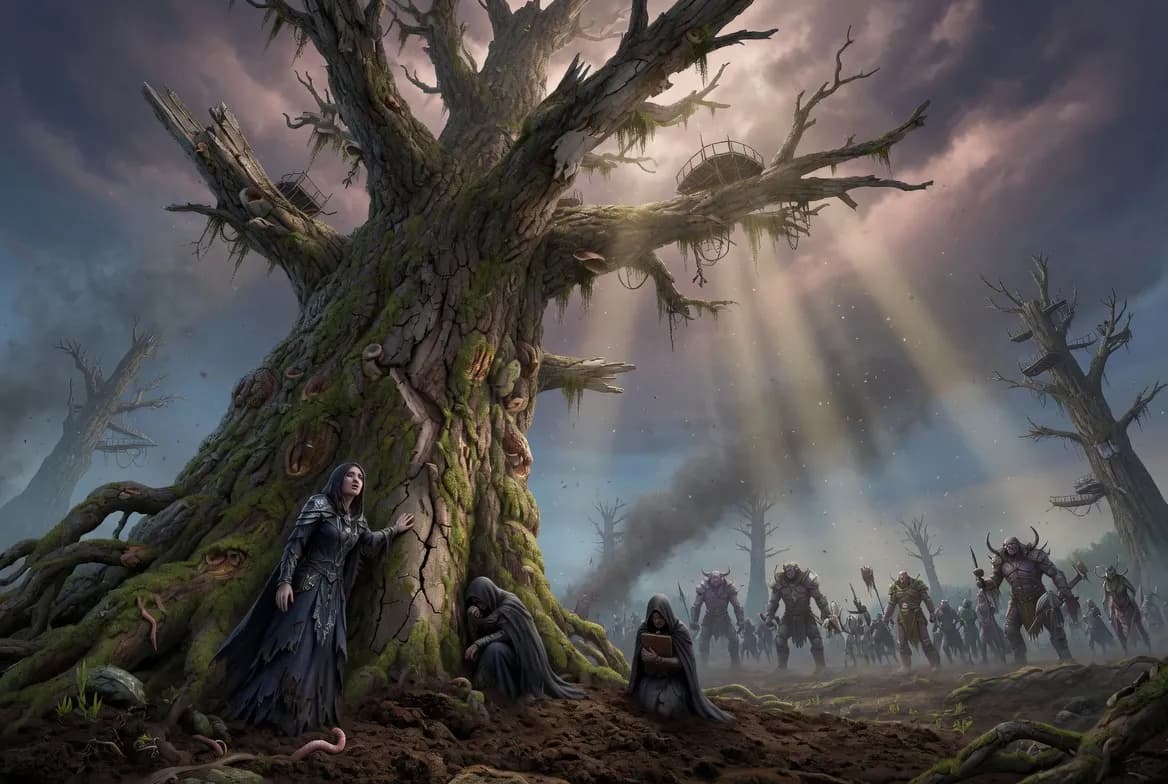
Not burn. Not break. Fall. Every tree in a region the size of a kingdom collapsed simultaneously, as if the concept of "standing" had been temporarily revoked. The trunks hit the earth together, and the sound was like the world clearing its throat before delivering a sentence of execution. Birds erupted from the canopy in the last instant before it ceased to be a canopy, millions of them, a black cloud of wings and panic that was swallowed almost immediately by the dust and the roaring and the terrible, grinding, geological scream of a landscape being rewritten by forces that did not care what had been written there before.
Sheyar ran. He ran with the full speed of a Kithara in terror, which was very fast indeed, and it was not fast enough. The shockwave caught him and threw him forward, and he tumbled across the steppe like a leaf in a gale, and when he finally stopped he was eleven miles from where he had started, and three of his ribs were broken, and the forest he had known his entire life, the forest his Pride had hunted in for twelve generations, was a flat, grey field of splinters and silence.
The second day was worse.
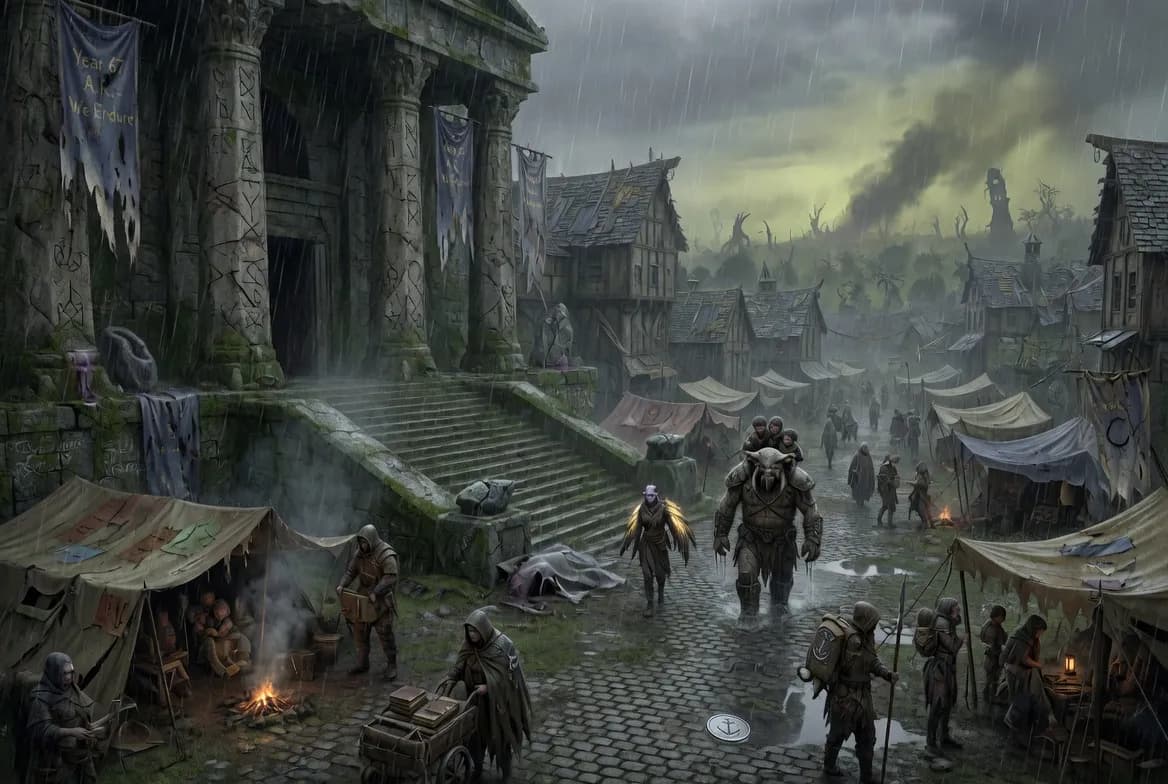
In Talor, the walls cracked at noon. Not the old walls. The new walls, the ones reinforced with Grundir-forged iron and Vaelith-blessed stone. The ones that were supposed to be unbreakable.
Marren of Talor, the textile merchant's daughter who had grown into a merchant herself, who had inherited her mother Deshra's stall and her mother's habit of double-prayer, though she had abandoned the prayers years ago, stood in the lower market and watched the eastern wall of the city split from foundation to parapet. The crack was not jagged, the way natural stone breaks. It was precise, a clean, vertical line, as if someone had drawn a blade down the wall's face and the stone had parted in deference.
Through the crack, she could see the plains beyond the city. They were on fire. Not with natural fire. The flames were white on one side and copper on the other, and where the two colors met, the fire turned a sick, bruised purple that hurt to look at. The grass burned. The soil burned. The air burned, and the heat that poured through the crack in Talor's wall was not the heat of flame but the heat of meaning, the concentrated, unbearable warmth of two divine natures trying to occupy the same point in reality and reality refusing, splitting, screaming.
People ran. Of course they ran. The market emptied in minutes, merchants abandoning their stalls, customers dropping their purchases, children screaming for parents who were screaming for children. Marren did not run. She stood in her mother's stall and watched a city she had been born in come apart at the seams, and she felt not fear, exactly. Fear was too simple. She felt the way a clay pot must feel when the kiln is too hot: a structural awareness that she was being subjected to forces her design was never meant to withstand.
The great fountain of Solanthis in the central square, carved from a single block of white marble, fed by an underground spring that the Archon himself had blessed, exploded. Not cracked. Exploded, the marble shattering outward in a spray of white shrapnel that killed fourteen people in the square. The spring beneath it began to boil, sending a column of steam into the sky that smelled of ozone and copper and something else, something sweet and terrible that Marren would later identify as the smell of prayer, the concentrated residue of a thousand years of mortal devotion being burned off in an instant because the god it had been directed toward was too busy fighting to receive it.
Across the city, Kael'thar's forge on the Hill of the Three Fires erupted. The sacred flame that had burned there for centuries, tended by a succession of blacksmith-priests who considered the duty the highest calling of their faith, expanded. It did not spread the way fire spreads, consuming fuel and advancing. It grew, like a living thing, like a tree made of flame putting out branches of molten copper that reached across the hilltop and set the white temple of Solanthis ablaze.
The temple burned with a white fire that fought against the copper flames. Two divine fires on one hilltop, consuming each other and the hill beneath them. The blacksmith-priests and the truth-priests died together, and in their dying they achieved the unity that their gods had refused. They were equally dead, equally irrelevant, equally forgotten in the clash of powers that had never truly seen them as anything but instruments.
Marren watched the hill burn. She watched the fire climb so high it touched the torn sky. And she thought of her mother, Deshra, who had prayed to both courts and been answered by neither, and she understood something that would stay with her for the remaining forty years of her life:
The gods do not hate us. That would require them to see us. We are the ground they fight on. The ground does not have opinions about the battle. The ground simply breaks.
The third day was the day the rivers changed their minds.
The Aethis, the great river that bisected central Aradoth, flowing from the Dragonspine headwaters to the western sea, stopped. Not dammed, not frozen, not diverted. Stopped. The water stood motionless in its bed, trembling, as if the river itself was afraid to choose a direction because every direction led toward a god that was destroying whatever it touched.
Then it reversed.
The Aethis flowed backward for six hours. It flooded the headwater valleys. It drowned settlements that had been built on high ground specifically because they were above the flood line, because flood lines are calculated on the assumption that water will continue to obey the laws of physics, and on the third day of the Sundering, the laws of physics were suggestions that the gods were ignoring.
In the caldera of Vorath Kel, something changed. The volcano had been screaming since the first day, a continuous, subsonic roar that had shattered windows in settlements sixty miles away. On the third day, it went silent. The silence was worse. Vorath had stopped raging, and Vorath only stops raging when he has found something more satisfying than rage.
He had found focus.
The western sky darkened. Not with clouds, but with intention. Vorath gathered himself, and the gathering was visible from a hundred miles away: a compression of the air, a thickening of reality, a sense of immense weight being concentrated into a single point, a fist being clenched on a scale that made mountains look like pebbles.
Valdris saw it. Felt it. The lattice of perfect order that was his nature oriented itself toward the incoming blow, every line of force realigning, every geometric pattern shifting to absorb what was coming. He did not retreat. Retreat was not in his nature. He braced, and in his bracing, the mountains east of the Aethis straightened, literally straightened, their slopes becoming more regular, their peaks more symmetrical, as Valdris unconsciously imposed his nature on the geography around him.
Vorath struck.
The blow was not physical. It was ontological, a rejection of order itself, a concentrated expression of the principle that the universe is not structured, is not organized, is not governed by rules, but is instead a howling chaos temporarily wearing the mask of causality. It hit Valdris's lattice and the lattice held, but the world behind the lattice did not.
The impact zone was twenty miles wide. Within that zone, geography became negotiable. Hills inverted. Lakes fell upward, the water hanging in the air for long, surreal minutes before crashing back down as rain that was somehow salt, as if the fresh water had been transmuted by the shock. Trees grew downward, their roots reaching for a sky that was no longer where sky was supposed to be. Animals, deer, wolves, birds, insects, froze in place, caught between one heartbeat and the next, trapped in a moment that had been knocked loose from the sequence of time.
Many of them are still there. Travelers in the Shattered Vale report finding them: a wolf mid-leap, a hawk mid-dive, a spider dangling from a thread of silk that connects to nothing. They are not dead. They are not alive. They are paused, and no one has found a way to un-pause them, because the moment they are trapped in no longer connects to the moment that was supposed to come next.
By the third evening, the mortal dead numbered in the thousands. Not soldiers. Not combatants. Miners and merchants and hunters and farmers and children and old men and women who had been standing in the wrong place when reality decided it no longer had to be consistent.
The Grundir lost two settlements in the Dragonspine, not to collapse, but to displacement. The mountains shifted, and the settlements were simply no longer where they had been. Some say they were swallowed by the stone. Some say they were moved, transported to some other location that no one has found. The Grundir do not speak of it. There are names carved in the deepest halls of Grayhold, names of the lost, of the displaced, of the people who went to sleep in a mountain that existed and woke up nowhere, or did not wake up at all.
The Kithara lost the Verdant Expanse and with it the hunting grounds that had sustained four Prides for as long as the Prides had existed. They adapted. The Kithara always adapt. But the songs they sing about the Expanse are not songs of mourning. They are songs of bewilderment. The forest was there. Then the gods disagreed about something the Kithara had never cared about. Then the forest was gone. The songs ask a question that has no answer: What did we do?
Nothing. They had done nothing. That was the answer, and it was not a comfort.
The Hearthborn lost Talor's eastern quarter, the Hill of the Three Fires, the Great Market's southern wing, and an estimated three thousand citizens. The death toll is uncertain because many of the bodies were never found, not buried in rubble, but simply absent, removed from existence by the intersection of two divine presences that had compressed the physical space they occupied into something that could no longer sustain the complex arrangement of matter that constitutes a person.
The Vaelith, safe in their distant forests, recorded everything. Their accounts are the most detailed, the most precise, and the most clinical. They describe the Sundering the way a physician describes a plague: with exhaustive accuracy and no visible emotion. This is not because the Vaelith did not care. It is because what they witnessed exceeded their capacity for emotional processing, and they retreated, as the Vaelith always retreat, into the fortress of documentation.
Their records note a detail that no other race's accounts include: during the three days of the Sundering, the background hum of the world, the echo of Aethon's creative voice, the sound beneath everything, the vibration that the Vaelith called the Green Communion, dropped by nearly a third. The gods' war was not only reshaping the world's surface. It was consuming the residual creative energy that held the world together. Every blow struck, every divine nature exerted, every moment of the three-day catastrophe was burning through the finite legacy of Aethon's voice.
The Sundering was not just destroying the present. It was consuming the future. And if it continued, there would not be enough of Aethon's echo left to sustain a world worth fighting over.
On the evening of the third day, the fighting paused. Not stopped. Paused, the way a storm pauses when the wind shifts, gathering itself for a new assault from a new direction. The gods had not exhausted themselves. Gods do not exhaust. But the mortal world beneath them was beginning to come apart in ways that even divine beings could not ignore, because the stage was cracking and even gods need somewhere to stand.
It was in this pause, this brief, trembling, blood-soaked pause, that a small figure emerged from the ruins of Talor's diplomatic quarter.
She was Tesseri. She was four feet tall. She was covered in dust and someone else's blood, and she was carrying, of all things, a ledger.
Her name was Greshen. History would call her Greshen the Unlikely, and for once, history would be guilty of understatement.
But that is the next chapter's story.
What remains of this one is the silence that settled over Aradoth on the third evening. Not peace, not resolution, but the exhausted, shattered quiet of a world that has survived something it was not designed to survive. The silence of a battlefield where the soldiers are mountains and the casualties are rivers and the wounded are the laws of nature themselves, limping, fractured, uncertain whether they still apply.
The Grundir returned to their broken mines and began to dig. The Kithara stood on the edge of a plain of splinters that had been a forest and began to sing. The Hearthborn walked through the cracked streets of Talor and began to count their dead.
And high above, in the torn and mended and torn-again sky, the gods waited. Not finished. Not satisfied. Merely interrupted. The war was not over. It was paused.
But in that pause, a Tesseri with a ledger was about to do something that no army, no fortress, no prayer had managed.
She was going to make the gods listen.
Thus ended the three days that broke the world's back. Not its spine. The world still stood, still turned, still carried its mortal burden from dawn to dusk and back again. But something fundamental had cracked, something in the relationship between the divine and the mortal, between the powers that shaped reality and the people who had to live in it. Before the Sundering, mortals had looked up at the gods with awe. After the Sundering, they looked up with something else. Not hatred. Not defiance. A quiet, terrible, unforgiving awareness.
The gods are real. The gods are powerful. And the gods will destroy everything you love without noticing they have done it.
This is the knowledge that the Sundering taught. This is the scar it left on every race, every nation, every family that survived it. Not a wound in the earth, though those are real and visible and will endure for millennia. A wound in trust. A crack in faith. The moment the mortal races of Aradoth understood that the divine is not the same as the good, and power is not the same as care.
The mountains will heal. The rivers will find their courses. The forests will grow back, given time.
Trust, once broken, does not grow back. It must be rebuilt. And the cost of rebuilding it is the subject of everything that follows.
Select text to add a note.