The Accord
In which the desperate find common ground, the proud learn to bend, and victory tastes of ash and weeping.
"Nine races sat at one table for the first time in the history of the world. By the end of the first day, three had threatened to leave, two had threatened war, and one had submitted an invoice for the chairs. By the end of three months, we had an alliance. I still do not understand how. I was there for every session, and I still do not understand how."
—Consul Maren Aldwyth of Talor, private correspondence, Year 1 A.R.
I. The Table
They chose Talor because no one else would have them.
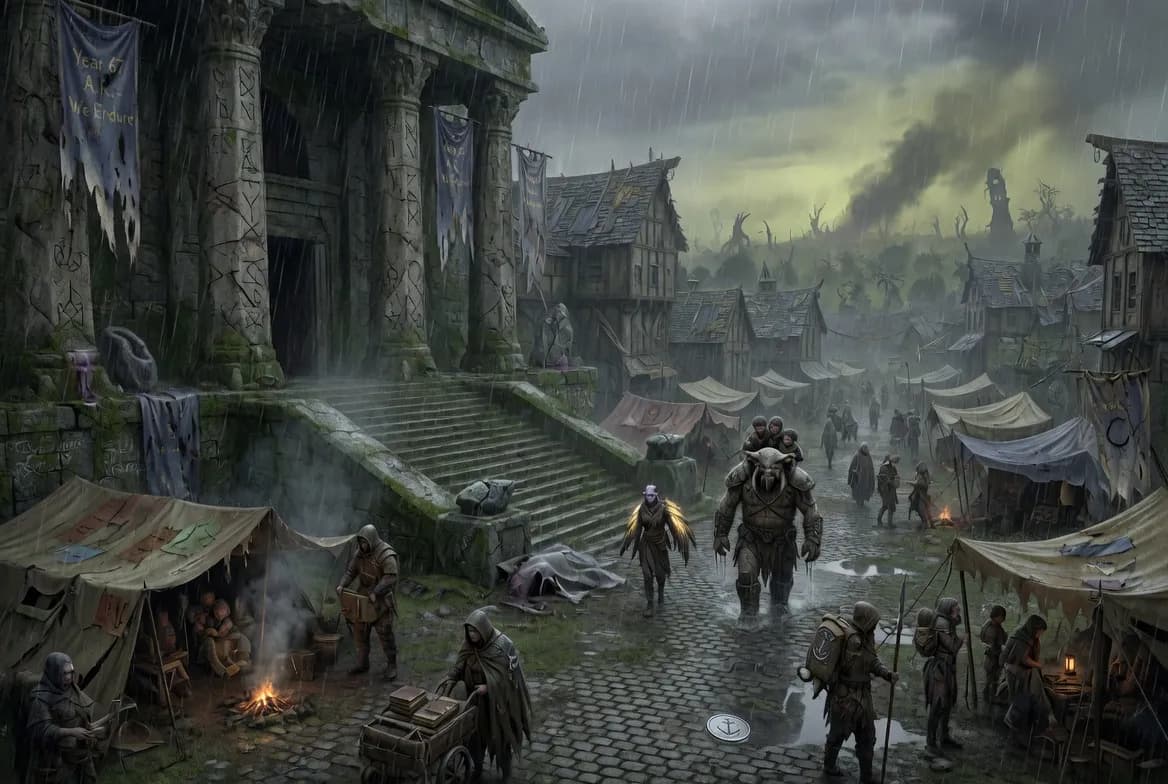
The Merchant Council prefers to say Talor was chosen because it was the largest city, the most cosmopolitan, the natural crossroads of diplomacy. All true. But the deeper truth was simpler: Talor was the city with the most to lose. The Blight was sixty miles east. The refugee camps had tripled the population. The granaries were half-empty. The market square, cracked by the earthquake of the Breaking, had been repaired with mismatched stone that reminded everyone, every day, that the world had broken and the cracks had only been plastered over.
Consul Maren Aldwyth, elected three months before the Breaking and inheriting a crisis he had not campaigned for, understood that Talor would fall within a decade if the races could not be made to cooperate. He sent the invitations himself, written in his own hand, in the language of each recipient, sealed with Talor's sigil in wax the color of dried blood. The Merchant Council objected to the color. He told them the color was the point.
II. The Delegations
The Grundir came first, because the Grundir were always first when there was work to be done.
Hold-Speaker Brennar Ironvault led the Grundir delegation: seven members, compact and stone-faced, wearing the formal armor of Grayhold. Brennar was old for a Grundir, which meant ancient by any other reckoning. He had fought in the Deepvein War. The scar across his left cheek, where an Arak'thur axe had nearly taken his jaw, he wore the way some men wear medals.
The Hearthborn were already there. Consul Aldwyth had assembled his team of five, the most important of whom was the least political: a scribe named Pellam, whose handwriting was so precise that other delegations would request copies of his notes. His memoir, Three Months in Talor, is the primary source for everything that follows. He had no loyalties beyond accuracy, which made him useless as a diplomat and invaluable as a witness.
The Vaelith arrived quietly, which was unprecedented. No banners. No song. Three representatives in travelling cloaks, entering through the eastern gate as if hoping no one would notice. Lirael of House Aelindra led them, young for such a post, barely two centuries, chosen precisely because she was not old enough to have been complicit in Aeloran's crimes. The Houses had sent their youngest to bear the shame the eldest had earned. With her came Commander Aereth of House Thandor and an archivist named Seravyn of House Veylith, who spoke rarely and wrote constantly.
The Kithara sent Pride-Speaker Rashaan of Pride Suneater. He arrived alone, which was itself a statement; among the Kithara, to send one where others send many is to say: This one is sufficient. He listened more than he spoke. When he did speak, the room went quiet, because Rashaan said exactly what everyone was thinking and no one was willing to voice.
The Vyssari delegation was three members of the Conclave, led by Elder Sothis. They brought a current-reader named Tessandre, trained to perceive the emotional undercurrents of a conversation through bioelectric fields that the Vyssari could sense in all living things. When the other delegations objected, Sothis said, "She is here to help us listen. Listening is not spying."
"It is when you're better at it than everyone else," Rashaan observed.
The Arak'thur arrived last, and they arrived loud. Jarl Thessa Frostspear, granddaughter of Korven, hero of Trandalar's evacuation, led four warriors who had to duck to enter the council chamber and whose combined weight made the floorboards creak in protest. The Arak'thur had lost everything. Trandalar was gone. Three hundred of their best had died on a dock. Thessa was here because the alternative was extinction, and she intended to make certain everyone understood that. She wore her grandfather's axe across her back. The blade was salt-pitted from the crossing. She had not cleaned it.
The Seraphim sent Exalted Aurelion, who pushed hardest for the alliance; the Archonate viewed the Caesura as a divine test in which the mortal races would be forged into something greater, or found wanting. The Korvathi sent Brandmaster Vyssa Ashmark, who arrived in smoke-darkened leathers and said nothing for the first three days. The Korvathi were ambivalent about everything except their own ambivalence. The Tesseri sent Trade-Speaker Gellen Copperworth, who arrived with two assistants and a rate card. Within the first hour he had offered to facilitate negotiations for a fee of two percent and to provide financial infrastructure for joint military operations for three percent. When Aldwyth pointed out the second offer was more expensive, Gellen smiled and said, "Infrastructure is worth more than words, Consul. You can verify this by examining any bridge."
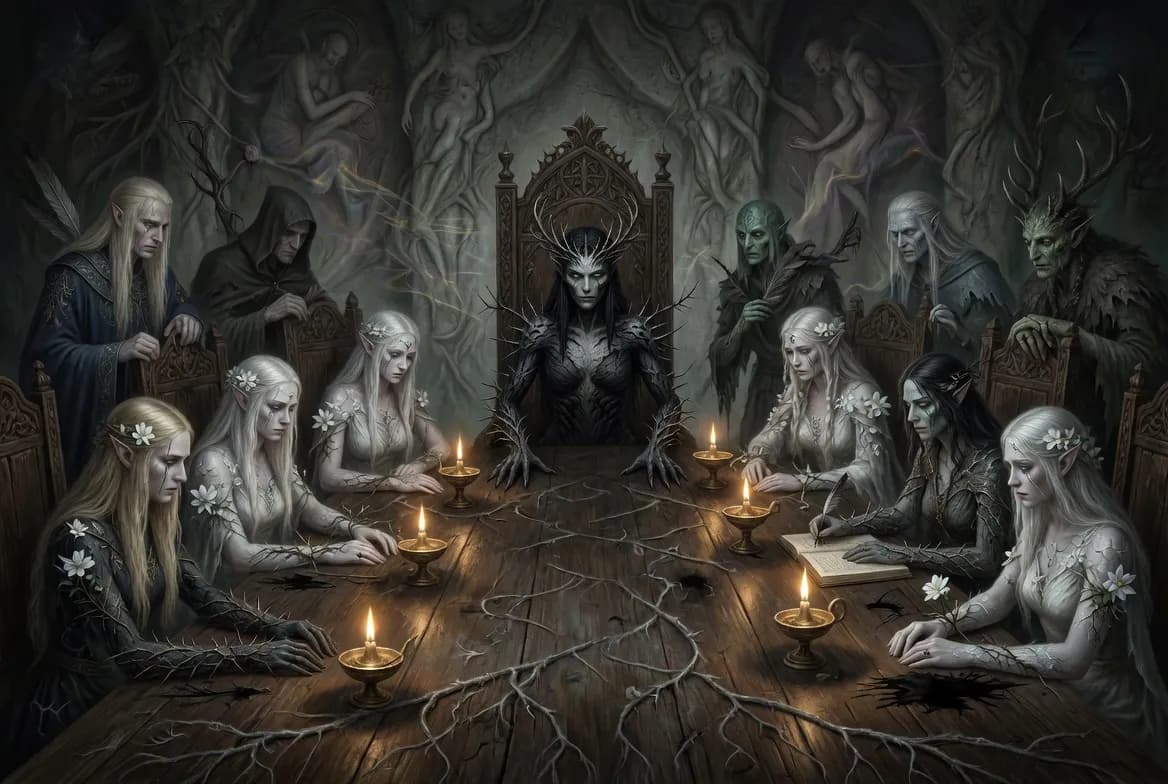
One chair remained empty throughout the negotiations. Consul Aldwyth had ordered it placed at the table and had instructed his staff to set a place before it each morning: plate, cup, utensils, all untouched, all cleared away each evening. When Brennar asked who the chair was for, Aldwyth said: "The Dryathi."
The room went quiet. Lirael's hands, folded on the table before her, went white at the knuckles.
"They will not come," Lirael said, after a silence that lasted long enough to become uncomfortable. "They cannot. They are—"
"I know where they are," Aldwyth said. "And I know why. The chair stays."
It stayed. For three months, the empty chair and the untouched place setting served as a silent indictment that no one acknowledged and no one could ignore. Pellam recorded that on several occasions, delegates addressed their remarks to the empty chair, not consciously, but in the way that a guilty conscience turns the eyes toward the evidence of its guilt.
III. The Fractures
The negotiations nearly collapsed on the fourth day.
Brennar Ironvault opened the morning session with a formal demand, delivered in the flat cadence of Grundir legal tradition: the Arak'thur must be excluded from any alliance. He cited the Deepvein War. He cited a century of border violations. He cited, with the specificity of a people who carve their grudges in stone, the names of forty-seven Grundir miners killed in the collapse of Shaft Seventeen, which the Arak'thur had triggered by undermining the mountain's western face during a territorial dispute over hunting rights that had escalated, as territorial disputes do, into something indistinguishable from war.
Thessa Frostspear stood. Her chair hit the wall behind her.
"You want to speak of the dead?" she said. Her voice was not loud. It did not need to be. The Arak'thur voice comes from the chest, from the belly, from somewhere below the diaphragm where resonance lives. "You want to count bodies? I will count with you, Grundir. I will start with the three hundred who died on a dock in Trandalar so that I could stand in this room and listen to you recite a list of names from a war that your mines started."
"Our mines were within our territorial—"
"Your mines collapsed our hunting camps. Our camps that had stood for six hundred years before your drills found the seam beneath them. You mined under our feet and when the ground opened and swallowed our children you called it a territorial dispute."
Brennar's hand went to the table. Not to the axe at his belt, as that would have been a declaration. To the table. His fingers pressed against the wood until the grain creaked. "We offered compensation."
"You offered gold for our dead. We are not Tesseri."
"I take no offense at that," Gellen Copperworth murmured, "as it was clearly intended."
Consul Aldwyth let them argue. Pellam records that he sat with his hands folded and his expression neutral for seventeen minutes while the Grundir and Arak'thur delegations excavated a century of grievance with the thoroughness of miners working a vein. He let them reach the bedrock of their anger, the place where the specific complaints end and the fundamental incomprehension begins, where each side cannot fathom how the other can fail to see that they are the injured party.
Then he spoke.
"Hold-Speaker Brennar. Jarl Thessa. The Blight does not care about the Deepvein."
Silence. Not agreement. Something rawer. The silence of two people who have been reminded that the thing they are arguing about is smaller than the thing that will kill them both.
"The Blight will reach Grayhold's northern passages within fifteen years at current rates of advance," Aldwyth continued. "It will reach Mahagra's coastline within ten. You can spend those years arguing about a war your grandparents fought, or you can spend them building something that gives your grandchildren a chance to fight about it later. I prefer the second option. I suspect, if you are honest with yourselves, that you do too."
Brennar sat down. Thessa did not. She stood for a long moment, her grandfather's axe a weight across her back, staring at the Grundir delegation with eyes that held nothing so simple as hatred. Then she said: "I will not exclude anyone from this table. And I will not apologize for defending land that was ours before the Grundir learned to count."
"And I will not apologize for mining stone that was there before the Arak'thur learned to walk," Brennar replied.
They glared at each other. It was not resolution. It was not even a truce. It was the mutual recognition that the argument would have to be set aside, unfinished, like a wound that is bandaged but not cleaned. It would fester. Everyone in the room knew it would fester. But festering takes time, and time was the one resource they could not afford to spend on old wounds.
The Vaelith crisis came in the second week. Lirael had been strategically quiet, voting with the majority, offering magical expertise, never discussing the Breaking or Aeloran or the seven hundred Dryathi who had died screaming in a ritual chamber beneath the city she was asking the alliance to help reclaim.
It was Rashaan who forced the issue. "The seat is set for the Dryathi," the Kithara said. "It is set every morning. It is cleared every evening. And every evening, the Vaelith delegation leaves this room without acknowledging why it is empty."
"What would you have me say, Pride-Speaker?"
"I would have you say what happened."
"You know what happened."
"I know what the world knows. I want to hear what the Vaelith know."
Lirael spoke. She told them the truth. Not the political version, not the careful language of "partnership" and "cultural integration." She told them about the binding of the Rootsong. About Dryathi used as magical conduits, burning out, dying quietly, replaced without comment. About gardens so beautiful that visitors wept, tended by slaves whose consciousness had been overwritten so thoroughly that they smiled while they worked, because the smile had been written into the binding. About the ritual. About seven hundred arranged in concentric circles. About the scream that was not a scream, because the binding did not permit screaming, so instead the Rootsong itself screamed for them, a frequency of anguish felt in the bones.
When she finished, the room was silent for a long time.
"The chair stays," Lirael said. "And if the Dryathi come to this table, in a year or a decade or a century, the Vaelith will answer whatever questions they bring. I cannot apologize for what Aeloran did. An apology implies the crime can be measured. What we did to the Dryathi cannot be measured. It can only be remembered."
Thessa Frostspear, who had spent two weeks refusing to look at the Vaelith delegation, turned to Lirael and gave a single, short nod. The first gesture of respect any delegation had offered the Vaelith since the negotiations began.
The Kithara impasse came in week five. Rashaan listened to the proposed charter provisions and asked one question: "Who enforces this?"
"The Council," Aldwyth said.
"And if a Pride refuses the Council's ruling?"
The question exposed the fundamental tension at the heart of the Accord. An alliance that can compel its members is a government. A government of nine races, each with its own traditions of sovereignty, its own definition of authority, was impossible. Not difficult. Impossible.
It was Elder Sothis who proposed the solution, in the careful cadence of someone who has consulted seventeen centuries of ancestral memory before speaking. "Nothing happens," he said.
Rashaan's ears flattened. "That is not a solution."
"It is the only solution that permits this alliance to exist. The Accord cannot compel. It can only ask. And asking is only effective when the asked agree that the threat justifies the cost. This makes the Accord fragile. The fragility is not a flaw in the design. It is the design. An alliance that cannot be broken is a cage. None of you would enter a cage. You will enter this."
Rashaan regarded him for a long moment. "The Vyssari are infuriating."
"We have been told," Sothis replied.
IV. The Signing
The Charter of the Accord was signed on the first day of spring.
The provisions were pragmatic, stripped of poetry, built for a world that had no patience left for aspiration:
All signatory races would commit forces to the defense of the Blight frontier. No signatory race would wage war on another signatory race while the Caesura threatened. Trade between signatory races would be facilitated and protected. Disputes between races would be mediated through the Accord Council, not through violence. The city of Talor would serve as the seat of the Accord Council. And no race was required to surrender sovereignty. The Accord was an alliance, not a government.
Six provisions. Three months of argument distilled into six sentences that a child could understand. Gellen Copperworth observed that the document was short enough to fit on a single page and significant enough to change the world. Then he charged the Council for the parchment.
Each delegation signed in its own tradition. Brennar pressed his Hold-ring into hot metal. Thessa cut her palm and pressed it to the page, blood-oath, the only contract the Arak'thur recognized as unbreakable. Lirael inscribed her name in Vaelith script that glowed faintly. Rashaan left a claw-scratch in the pattern of Pride Suneater. Elder Sothis held the document and those near him felt warmth, as if the parchment had been briefly held in sunlight; the Vyssari method of binding an agreement to the Current. Aurelion spoke a word of light. Vyssa branded her mark with a thumb that glowed like a coal. Gellen signed in ink and attached a separate addendum outlining the Tesseri fee schedule for financial services rendered to the alliance.
Consul Aldwyth signed last. Plain pen. Common script. No magic, no blood, no metal.
The date was recorded as the first day of Year 1 of the Accord Reckoning. A new calendar, born not from hope but from the shared acknowledgment that the old way of counting time, measured backward from a catastrophe called Before Reckoning, was no way for a civilization to orient itself.
That evening, for the first and only time, all nine delegations ate together. Each brought something from their own tradition. The Vaelith brought nothing. They had nothing to bring. Feladan's orchards were Blight-dust. Lirael sat with an empty plate and drank water, and no one commented on it, because there are some courtesies that even bitter enemies can manage. The Seraphim and Korvathi ate at opposite ends of the table. Some alliances have limits.
V. The Long March
Twenty years after the Breaking. Twenty years of holding the line, of fortifying positions, of learning, slowly and painfully, with casualties that mounted in ledgers too thick to lift, how to fight an enemy that was not alive and could not be killed, only pushed back, contained, denied purchase inch by agonizing inch.
Twenty years, and the Accord Council voted to retake Feladan.
The decision was not unanimous. Brennar Ironvault, older now, slower, his iron-grey beard gone to white, argued that the resources would be better spent fortifying the existing line. Gellen Copperworth's successor on the Council presented a cost analysis that made several delegates physically ill. The Korvathi representative abstained, calling the operation "strategically romantic."
It was Thessa Frostspear who carried the vote.
"I lost my homeland," she said. "My grandfather died on a dock so that I could live. I will not tell the Vaelith that their home is not worth fighting for when I would burn the world to get mine back."
The Vaelith delegation, Lirael still among them, twenty years older and carrying the weight of it in her eyes, said nothing. They did not need to. Thessa had said it for them, and the fact that it was an Arak'thur who spoke for the Vaelith, an Arak'thur whose people had been enslaved by no one and displaced by everyone, whose only connection to the Vaelith cause was the shared experience of losing a home—that fact mattered more than any argument about strategy or resources.
The vote carried. The army assembled.
It was the largest combined military force in the history of Aradoth. Grundir engineers built siege equipment coated in Blight-resistant alloys. Kithara scouts ranged ahead, the only troops who could operate without torchlight, and torchlight drew the Shamblers. Arak'thur heavy infantry formed the vanguard. Hearthborn regulars held the center. Seraphim channelers provided healing; their light was the only thing that seemed to make the Blight flinch. Korvathi shock troops operated on the flanks, terrifying allies and worse enemies. Tesseri quartermasters kept the army fed, supplied, and paid.
And the Vaelith mages walked among them all, diminished but still the most powerful on the continent. They had spent twenty years studying the Blight and discovered that sustained Resonance, applied with precision, could reverse it. Not everywhere. Not permanently. But enough. Enough to reclaim a field. A grove. A mile of road. Mages working in shifts, pouring their strength into corrupted soil until the grey receded, until worms moved in the dirt again, until a green shoot pushed through the dead surface and the mage collapsed from exhaustion and was carried to the rear while another took her place.
Inch by inch. That was how you fought the Blight. Not with swords and glory, but with patience and soil.
The Great Forest had been the pride of the Vaelith Sovereignty: a thousand square miles of ancient woodland, trees older than civilization, canopy so dense that the forest floor existed in perpetual twilight. The Blight had turned it into something else. The trees still stood, but they were grey, brittle, dead in a way that went beyond death. Normal death is part of life; a fallen tree feeds the soil that grows the next tree. Blighted wood fed nothing. It stood in silent columns of petrified absence, and between the trunks, things moved that had no business moving.
The army entered the forest in early spring and did not emerge until autumn.
The fighting was unlike any war the chronicles had recorded. The forest was a maze of dead wood and grey light, and the enemy came from everywhere and nowhere. Shamblers rose from the corrupted soil in waves, relentless, tireless, unafraid, driven by an imperative that was not hunger or hatred but something worse: purpose. The Substantiators, crystallized nodes of anti-Resonance that anchored the Blight to the land, pulsed with a frequency that organized the Shamblers, directed them, made their chaos into strategy.
The army destroyed the Substantiators one by one. Each one was a battle. Each battle was a nightmare. Casualties mounted. The dead were carried back to the purified zone behind the advancing line, because leaving a body in Blighted territory meant watching it rise again wearing a friend's face. The Grundir engineers built carts for this purpose. They were called grief-wagons. No one used the official designation.
Three months in, a Kithara scout named Deshara of Pride Windrunner climbed the tallest dead tree on the ridgeline and reported that she could see Feladan: grey, skeletal, half its crown broken away, the living architecture of a thousand years reduced to something that looked like a hand reaching out of a grave. She did not mention that she had wept at the top of the tree. This was recorded only because a Vyssari current-reader, sensing the residual emotion hours later, noted it in the campaign log with characteristic precision: Scout Deshara, emotional discharge, elevated position, duration approximately ninety seconds. Nature: grief. Not for the Vaelith. For the trees.
The final push took six weeks. The Vaelith mages worked themselves to collapse and were replaced by fresh mages who collapsed in turn. The Arak'thur vanguard lost a third of its number. Thessa Frostspear took a wound in the final week that left her right arm useless; she fought the remaining days with her grandfather's axe in her left hand.
The last Substantiator stood at Feladan's roots, the largest anyone had seen, a spire of crystallized anti-Resonance twice the height of a Grundir, pulsing with a hole in the world's music. The Shamblers around it were different: faster, organized, almost intelligent. They formed defensive lines. They adapted to tactics. The implication, that the Blight could learn, was more frightening than anything else the army had faced.
The combined forces hit at dawn. The Substantiator cracked at midday. The sound it made is described differently by every account. Pellam wrote that it sounded like silence shattering. Thessa said it sounded like her grandfather's axe hitting ice. Lirael would not describe it at all.
The Blight began to recede from Feladan's roots. Slowly, like a tide going out, the grey retreated. The earth beneath turned from ashen nothing to honest brown dirt. A worm moved in the soil. A single, bewildered worm, pushing through ground that had been dead for twenty years, finding it alive again and not understanding why, simply doing what worms do because that is what life does when given the smallest chance: it continues.
The cheer that went up was heard in Talor, fifty miles away. Or so the chronicles claim. Distance makes liars of even the most honest witnesses. But the sound was real, and it was enormous, and for one bright, improbable, hard-won moment, nine races raised their voices together, and the sound they made contained war cry and prayer and song all at once.
VI. The Weeping
Feladan was scarred.
Half the city-tree was dead. Great sections of grey, brittle wood rose above the reclaimed earth like bones protruding from a healing wound. The living architecture, the spiral walkways, the crystal-threaded chambers, the canopy bridges, was largely destroyed. What remained had gone dark. The living wood that survived had grown in twisted, desperate patterns, reaching away from the Blight's center with the blind urgency of a plant seeking sun.
The Vaelith entered their city in silence. The other races stopped at the tree line. No one gave the order. But every soldier, engineer, scout, and mage understood, without being told, that this moment belonged to the Vaelith alone.
Lirael walked to the base of Feladan's trunk and placed her hand on the bark, half living, half dead, the boundary between them running directly beneath her palm. She stood there for a moment that Pellam measured at four minutes and seven seconds.
Then she wept. Not quietly. Not with the dignified restraint the Vaelith had cultivated over millennia. She wept the way a person weeps when the thing they have been holding finally collapses, loudly, messily, with the graceless abandon of genuine grief. Behind her, spreading through the Vaelith like a crack through ice, the others wept too. Commander Aereth sat down in the reclaimed dirt and put her face in her hands. Seravyn closed her book and pressed it to her chest, tears falling on the leather binding in a pattern that would stain the cover permanently.
No other race had ever seen the Vaelith weep. The Vaelith had built their identity on composure, on the certainty that they were the eldest and the wisest and the most beautiful. Weeping was an admission that beauty was not enough. That wisdom had not prevented catastrophe. That being the eldest meant only that you had more to lose.
The other races watched, and felt something they had not expected to feel: unity. Not the unity of the charter, the pragmatic, provisional agreement to cooperate because the alternative was annihilation. Something deeper. The recognition that every race in the Accord had lost something irreplaceable, and that the losing had made them, for one moment, the same.
And the Dryathi, absent from the table, absent from the campaign, driven into the deep forests by trauma that would take decades to heal, had lost the most of all. The empty chair. The untouched place setting. The silence where a voice should have been.
The feeling didn't last.
It never does. But for that one unrepeatable moment, standing in the ruins of a city that should have stayed dead and didn't, watching a people they had every reason to resent weep for a home they had fought and bled and died to return to them, the races of Aradoth were one people.
Pellam recorded the moment. He recorded the date, the weather, the duration of the Vaelith's weeping (twenty-three minutes), and the silence that followed. Then he wrote, in the margin of his notebook, in handwriting less precise than his usual standard, a single observation that was not part of the official record:
I think we could have been this. I think, if we had chosen differently, if we had been braver or less proud or simply luckier, we could have been this all along. But we didn't, and we weren't, and we aren't. And the Blight is still out there. And tomorrow we will go back to being nine races who happen to share a table. And the chair for the Dryathi will still be empty.
It will have to be enough.
Select text to add a note.