The Knife's Edge
In which the world the you enter is balanced between memory and silence.
"The candle does not know when it will go out. It only knows that it is still burning. This is not hope. It is something older than hope. It is the stubbornness of light in a room that is slowly filling with dark." —Essara of the Aethon Seekers, from the Fragments, undated
The sixty-seventh year of the Accord Reckoning begins with rain over Talor.
It is not remarkable rain. It does not carry omens or portents. It is grey and steady and cold, filling the gutters of the merchant quarter, running in thin rivers between the cobblestones, dripping from the awnings of the trade houses where Tesseri factors huddle over their ledgers, arguing about futures contracts in voices too quiet for the rain to drown. The rain falls on the Accord Council Hall, on its cracked dome and its patched roof and its steps that were white marble once and are now the color of old bone, worn smooth by sixty-seven years of diplomatic feet. It falls on the temples and the barracks and the refugee quarter and the war memorial and the taverns where soldiers on leave drink too much and talk too loudly about things they saw at the front that they would prefer not to have seen.
It is ordinary rain. Worth noting because ordinarily, in the histories and the chronicles and the sacred texts, rain means something. Rain is cleansing or punishing or prophetic. Rain is the sky weeping for the sins of the world.
This rain is just wet.
The world in the sixty-seventh year of the Accord is very tired of things meaning something.
I. The Line
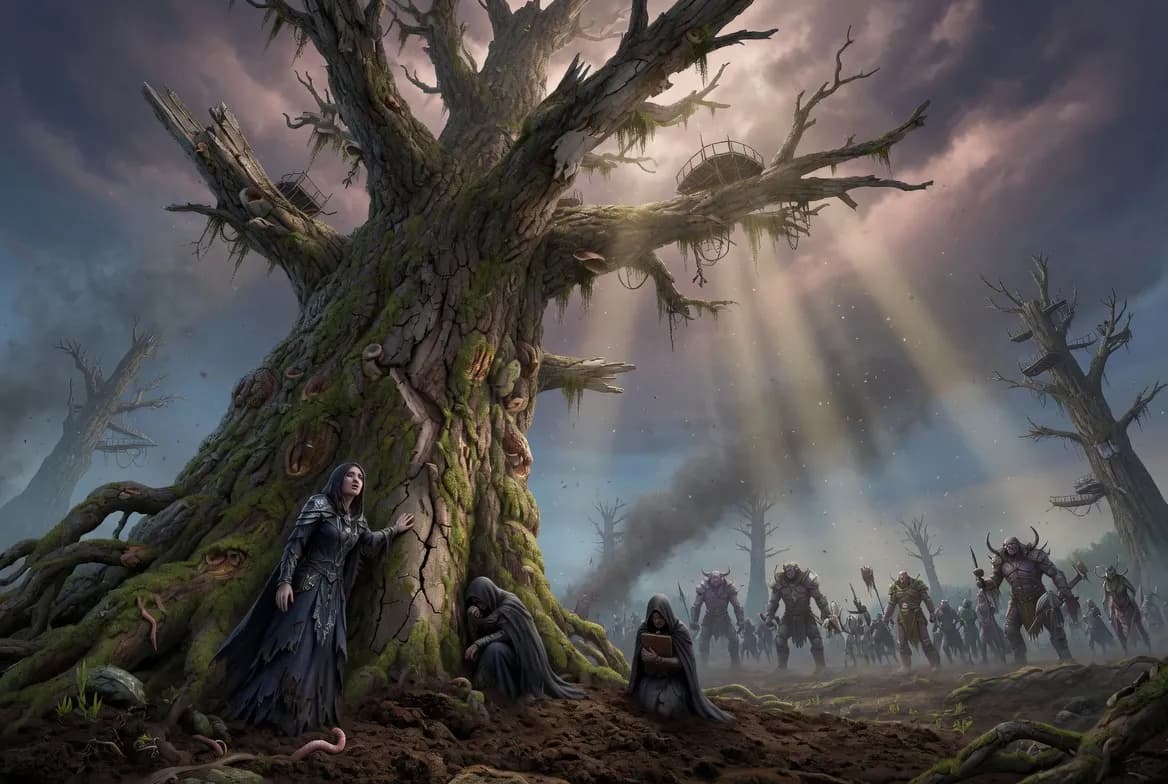
The front line runs from the Cleft of Aeshan in the north to the Drowned Coast in the south, a ragged boundary roughly five hundred leagues long that separates the living world from the Blight. On maps it looks clean: a bold red stroke drawn by cartographers who have never been closer to the Caesura than the distance from which it looks like a smudge on the horizon. In reality it is a zone, not a line. Miles wide in places, a gradient from healthy earth to sick earth to dead earth to the grey nothing that is not even dead, because death implies something that was once alive.
The soldiers who hold this zone have a name for it. They call it the Pale.
Not the Pale between Sanctus Aerie and Vorath Kel, where Seraphim and Korvathi play their ancient game of threat and counter-threat. A different Pale. The one where reality itself grows thin and uncertain, where the ground is the color of old ash and the air tastes of copper and static, where your shadow sometimes points the wrong way and your thoughts sometimes come back to you rearranged, as if something had picked them up and put them down again in a slightly different order.
A decade of stability on the front. The generals call this a strategic stalemate. The politicians call it a managed situation. The soldiers call it waiting to die.
The stability is deceptive. The Caesura does not need to advance to win. It is entropy: the tendency of all things to become less than what they are, the slow unwinding of pattern into noise, of song into silence. Every day that the living races spend feuding over mining rights and trade tariffs and theological disputes and succession crises, the Caesura grows stronger. Not because it is doing anything. Because the living are doing less.
The front is held by a patchwork of forces that would be comical if it were not also, somehow, functional. The Grundir defend their mountains with a ferocity that borders on the geological. They do not retreat because retreating is not a concept that stone understands. The Kithara scout the frontier with an efficiency that makes the joint command uncomfortable, because the Kithara scouts report directly to their Pride leaders and only share intelligence with the Accord when the Pride leaders decide it is convenient. The Hearthborn commit the largest military force, because the Hearthborn have the largest population, and because the Hearthborn have built an entire economy around the logistics of war: the supply chains, the contracts, the armories and field hospitals and the sixteen different forms required to requisition a replacement sword.
The Seraphim Celestial Guard is the most effective anti-Caesura force in the world. Their combat training integrates divine Resonance in ways that no other military tradition can replicate. A single squad of Celestial Guard can purify a corrupted acre in hours, work that would take a conventional force days. They are brilliant. They are disciplined. They are deployed primarily to protect Seraphim holy sites, not the common front, because the Archonate has its own priorities, and the Archonate's priorities have always been the Archonate.
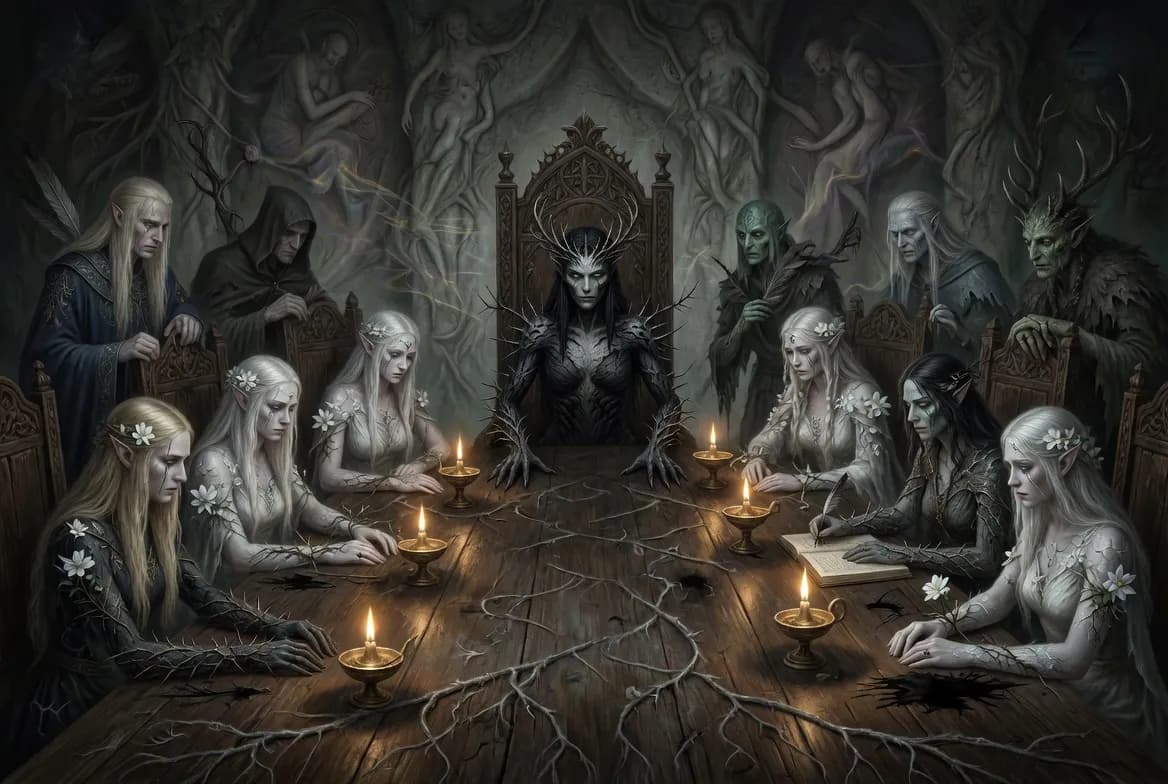
The Vaelith contribute their mages, fewer now than in the early days, their traditions diminished by the Breaking's toll on the creation language, but still the most powerful practitioners of Resonance on the continent. The Dryathi contribute their Thornborn warriors, who fight the Blight with a hatred that is personal and ancestral and rooted in the knowledge that the Caesura is consuming the very substance of the Rootsong. The Vyssari observe, document, and offer strategic assessments of startling accuracy that the joint command usually ignores because the Vyssari deliver them in the past tense, as if the outcomes have already occurred and they are merely reporting on history.
The Arak'thur contribute what they can, which is less than they want and more than anyone expects. They are refugees. They have no homeland. Their warriors fight with the desperate energy of people who have already lost everything once and are determined not to lose it again. They are also, in a quiet way that no one talks about, the only soldiers on the front line who have actual experience with losing a continent to the Blight. When the Arak'thur veterans say "this position is not holdable," the smart commanders listen.
And the Korvathi? The Korvathi do not officially contribute to the front line defense. The Infernal Concord has its own interests, and those interests occasionally align with the survival of the living world but are never subordinate to it. Korvathi warbands fight the Caesura when it threatens their territory. They do not fight it for anyone else's benefit. This is doctrine, not cruelty. The Korvathi believe that strength sharpened by adversity is the only strength worth having, and that protecting the weak from the consequences of their weakness is a form of sabotage.
The Tesseri do not fight at all, in the traditional sense. They fund. They supply. They insure. They have calculated the cost of the Caesura's advance per mile, per year, in seven different currencies, and they have portfolios hedged against every possible outcome up to and including the total extinction of civilization, which is covered under a special instrument called a Terminal Contingency Bond that pays out in an unspecified denomination to an unspecified beneficiary, and which the Tesseri consider a masterpiece of financial engineering and which everyone else considers evidence that the Tesseri have lost their minds.
This is the army that holds the line against the end of the world. It should not work. It works anyway, barely, the way a bridge works when half its supports are rotten. Not because the engineering is sound, but because the remaining supports are bearing more weight than they were designed for and have not yet realized they are supposed to collapse.
II. The Cracks
Three years ago, a Seraphim Exalted was assassinated in Talor.
The Exalted, a high-ranking priest-commander named Aelwyn, was found in her quarters in the Seraphim embassy with a Korvathi ritual blade in her throat. The blade was an antique, traceable to a specific Korvathi warband, the Blackened Fang, that had been operating in the Pale for months. The Blackened Fang denied responsibility. The Seraphim did not believe them. No one believed them, because the blade was not merely a weapon but a theological statement: a ritual implement used in Concord death-rites, which meant that the killing was not a murder but a sacrifice, an offering to the Archfiends, performed in the heart of the Accord's capital.
The Celestial Compact held. It held because the alternative was a second Sundering, and the memory of the first was still written in the geography of central Aradoth: the Flattening, the Scar of Kael'thar, the places where reality had been argued out of existence by gods who could not agree on what it should be. But the Compact held the way a cracked pane of glass holds. Visibly, fragilely, with the understanding that the next blow would shatter it.
Since the assassination, the skirmishes have escalated. Not the god-war that everyone fears. Something smaller and in some ways worse: a series of probing actions, border violations, and retaliatory strikes that are individually insignificant and collectively catastrophic. A Korvathi warband sacked a Seraphim missionary outpost on the edge of the Pale. The Seraphim responded by reinforcing their garrisons along the Compact border. The Korvathi interpreted this as an aggressive posture. Both sides began deploying patrols to disputed territory. The patrols encountered each other. Some of these encounters ended in words. Some ended in blood.
The Accord Council has passed seventeen resolutions calling for de-escalation. The Seraphim and the Korvathi have complied with none of them, because the Accord has no enforcement mechanism, because the Accord was designed as an alliance of sovereigns, and sovereigns do not obey resolutions. They obey interests.
Meanwhile, in the north, the Blight creeps toward the Deepvein.
The Deepvein is a network of mines that runs beneath the Grundir mountains and extends into territory that the Arak'thur once claimed as hunting grounds. The mining war that these competing claims produced, seven hundred years ago, before the Breaking, before the Caesura, before any of the present crises, killed thousands on both sides and ended in a ceasefire that both races considered temporary. The mines were sealed. The grievance was preserved in amber.
Now the Blight is approaching from the northeast, and the sealed Deepvein has become a strategic crisis. The old mines contain deposits of Resonance-conducting ore, material that could be used to repair degrading Anchor Stones, to forge weapons effective against the Caesura, to build the infrastructure that the front line desperately needs. The Grundir want to open the mines. The Arak'thur are watching from Mahagra with the focused attention of a people who have been dispossessed once and can recognize the early signs of it happening again.
The Grundir say: the ore is beneath our mountains, in our tunnels, mined by our ancestors.
The Arak'thur say: your ancestors mined beneath our lands without permission, collapsed our hunting camps, poisoned our rivers. The Deepvein was sealed because your mining was an act of war. Opening it is an act of war.
The Accord Council has convened seven mediations. Each has ended without resolution. The eighth is scheduled for next month. No one expects it to succeed.
And Mahagra is overcrowded.
The city that was built from ships, from the hulls of the fleet that carried the Arak'thur south when Trandalar fell, was never meant to hold this many. Three generations of refugees, born on foreign soil, raised in a city that smells of salt and rust and the particular desperation of a people who are guests in a world that has not decided whether they are welcome. The young Arak'thur leave for Hearthborn cities and find work and find discrimination and find that being eight feet tall and descended from a lost civilization makes you either exotic or threatening, depending on the neighborhood.
Jarl Thessa is two hundred and eighty-seven years old. She has led the Arak'thur since the fall of Trandalar, since before the Accord, since the fleet, since the three hundred who stayed behind. She is the last living person who remembers what the northern mountains looked like before the Blight. She is the thread that connects the Arak'thur to what they were. And she is dying. Not dramatically. Not tragically. She is dying the way very old people die: slowly, in small surrenders, a little less present each season, her voice a little softer, her pauses a little longer.
When she dies, the Arak'thur will have no jarl. They will have no succession mechanism, because succession was handled by the Thing of Jarls, and the Thing of Jarls required seven Holds, and there are no Holds anymore. There is only Mahagra. There is only the hulls. There is only the question that has been deferred for three generations and can be deferred no longer: do the Arak'thur own Mahagra, or are they guests? And if they are guests, how long does a guest stay before they become either a resident or an intruder?
The Accord Charter is silent on this. The Accord Charter is silent on many things. The Accord Charter was written by desperate people who assumed they would be dead before anyone needed to answer the difficult questions. They were wrong. They survived. The questions survived. The answers did not.
III. The Ledger and the Lens
In Rachival, the Tesseri capital, two guilds are at war.
It is not a war of blades. The Tesseri do not fight with blades. They fight with interest rates and information monopolies and carefully timed rumors and the strategic withdrawal of credit from entities that have displeased them. This is worse than blades. A sword kills one person. A credit freeze kills an economy.
The Guild of the Ledger controls banking. The Guild of the Lens controls intelligence. For centuries they have maintained a profitable equilibrium: the Ledger moves money, the Lens ensures that the money moves safely, and both guilds take a cut that is large enough to make them indispensable and small enough to make them tolerable. This equilibrium has been one of the pillars of Etharian commerce. It is also, the other races are beginning to realize, one of the pillars of Etharian survival, because the Tesseri financial infrastructure is not merely useful. It is load-bearing. The supply chains that feed the front line, the insurance contracts that allow merchant ships to sail contested waters, the currency exchanges that enable trade between races that do not trust each other: all of it runs through Tesseri systems. All of it depends on the Ledger and the Lens maintaining their partnership.
The partnership is collapsing. The details are obscure. The Tesseri guard their internal politics the way the Grundir guard their deepest halls, with stone and silence and the understanding that outsiders will not understand what they find even if they manage to get in. But the effects are visible. Trade caravans delayed. Insurance premiums doubled. Letters of credit questioned. The small, precise tremors that precede a financial earthquake.
If the Ledger and the Lens go to open conflict, the economy of the Accord fractures. Not metaphorically. Actually. The supply lines that keep the front fed, armed, and functional depend on Tesseri logistics. The financial instruments that allow the Accord Council to fund joint military operations depend on Tesseri banking. The intelligence networks that provide early warning of Caesura surges depend on Tesseri agents.
The Tesseri's greatest strength, their indispensability, is also the world's greatest systemic risk. No one built a redundancy. No one imagined they would need one. The Tesseri were reliable the way gravity was reliable: always there, always functioning, not worth worrying about.
Gravity, it turns out, is something you only think about when the ground starts to move.
IV. The Ticking Bomb
In Feladan, in the sealed archives of House Veylith, there are documents that could end the world.
Not literally. Not the way Aeloran's ritual ended it, with fire and silence and the earth cracking open beneath a city-tree. These documents would end the world more slowly, the way truth ends things: by making it impossible to continue pretending.
The documents describe, in precise and terrible detail, how Aeloran's ritual worked. Not the theory; the theory is widely known, debated endlessly by scholars who treat the Breaking as an intellectual puzzle rather than a catastrophe. The documents describe the mechanism. The seven hundred Dryathi channelers. The way their Rootsong was harvested, not merely used but consumed, burned as fuel for a spell that was never meant to be powered by living souls. The way the Vaelith knew. The way the ritual's architects calculated the number of Dryathi deaths required to generate sufficient Resonance, debated the figure, revised it upward, and proceeded.
House Veylith has maintained the fiction that Aeloran's ritual was a noble but flawed attempt to save the world. A tragedy. A miscalculation. The kind of failure that inspires pity rather than rage.
The Dryathi suspect the truth. They have always suspected it. The Thornborn Ashk did not say "tell us the truth" when she joined the Accord. She said "we will not forgive until the truth is spoken." The precision of her language was not an accident. She already knew. She was waiting for the Vaelith to admit it.
They have not admitted it. Twenty-seven years of waiting, and the Vaelith have not admitted it.
The Dryathi-Vaelith alliance is one of the few functional cooperations on the Blight frontier. Vaelith mages and Dryathi Thornborn fight side by side against the Caesura with an effectiveness that neither could achieve alone; Vaelith Resonance and Dryathi Rootsong are complementary frequencies, and the combined force can purify corrupted land faster than any other method. This alliance is necessary. It is also built on a lie. And lies, like the Caesura, are patient. They do not need to hurry. They simply wait for the moment when the truth becomes heavier than the fiction can bear.
In the Thornheart, the Dryathi sacred grove, young Thornborn whisper about the archives. They whisper about what might be found if someone looked. They whisper about justice, and vengeance, and the difference between the two, which is smaller than the Bloomborn would like and larger than the Thornborn would admit.
The bomb ticks. It has been ticking for a century. No one knows how much time is left on the fuse.
V. The Deeper Dark
Something is wrong in the Blight.
This sentence has been true for a hundred and fifty years. The Blight is a wound in reality. Of course something is wrong. But the scouts and seers who patrol the front are reporting a new wrongness, a change in the quality of the darkness, and they are frightened in a way that they have not been frightened before.
The Caesura's creatures have always attacked in surges: waves of entropy-corrupted organisms that crash against the front line like grey tides, mindless, purposeless, driven by nothing except the fundamental tendency of the Caesura to un-create what Aethon created. The surges are terrible. They are also predictable. They follow patterns. They can be modeled, anticipated, defended against. The joint command has spent decades perfecting its surge-response protocols. The system works. The system has kept the front stable for ten years.
The system is based on the assumption that the Caesura is mindless.
The assumption is failing.
The surges are changing. They are targeting strategically valuable positions with a precision that entropy should not possess. They are deploying in formations: flanking maneuvers, feints, coordinated multi-point assaults that require the kind of tactical planning that requires a mind to plan. The creatures are not merely attacking. They are testing. Probing defenses. Finding weaknesses. Withdrawing when they encounter strength and returning, later, with a response to that strength.
In the deep Blight, the territory beyond the front, the corrupted heartland that no living scout has penetrated in years, the Substantiator network is growing. The Caesura's anchor points, crystallized anti-Resonance that strengthens its hold on consumed territory, are multiplying. For every Substantiator the living forces destroy, the Architects build two more, whatever and wherever they are. The arithmetic is simple. The arithmetic is terminal. The living races can only win by pushing faster than the Caesura rebuilds, and they are not currently pushing at all.
And beneath the arithmetic, beneath the strategy, beneath the formations and the probing and the patient multiplication of anchor points, there is a theory. A theory no one wants to believe, that everyone is quietly beginning to consider, that sits in the back of the mind like a splinter you can feel but cannot find.
The theory about Aeloran.
That he did not die in the Breaking. That his body was consumed but his mind survived, twisted by the very forces he tried to command, his knowledge of the creation language turned from making to unmaking. That the Caesura has always had intelligence. That the intelligence has always been his.
It is a theory. It is whispered in taverns and barracks and the private chambers of the Accord Council. It is whispered because saying it aloud, in a full voice, would mean admitting that the enemy is not a force of nature but a person. And a person can plan. A person can wait. A person who once knew how to speak in the voice of creation and now speaks in the voice of its opposite could be doing things in the deep Blight that the living races cannot imagine and are not prepared for.
The alternative theory, that entropy has spontaneously developed intelligence, that the void has learned to think, is perhaps more frightening still.
Either way, the front line's decade of stability looks less like a stalemate and more like a pause. The kind of pause that precedes something.
VI. The Fading Stones
The Anchor Stones are dying.
This is not a metaphor. The ancient waygate network, Aethon's infrastructure, built into the bones of the world during the Age of Making, maintained by Resonance and faith and the lingering echo of the creator's voice, is losing power. The degradation is slow. It has been slow for decades. But slow decay is still decay, and the network that allows rapid travel across Aradoth is failing.
Three Anchor Stones have gone entirely dark in the last five years. Seven more are unreliable; sometimes they function, sometimes they do not, sometimes they deposit travelers a quarter-mile from their intended destination, which is a minor inconvenience when the destination is a market square and a death sentence when the destination is a forward outpost on the Blight frontier. The remaining stones are operating at diminished capacity. Transit times are longer. Cargo limits are lower. The network that once moved armies is struggling to move supply caravans.
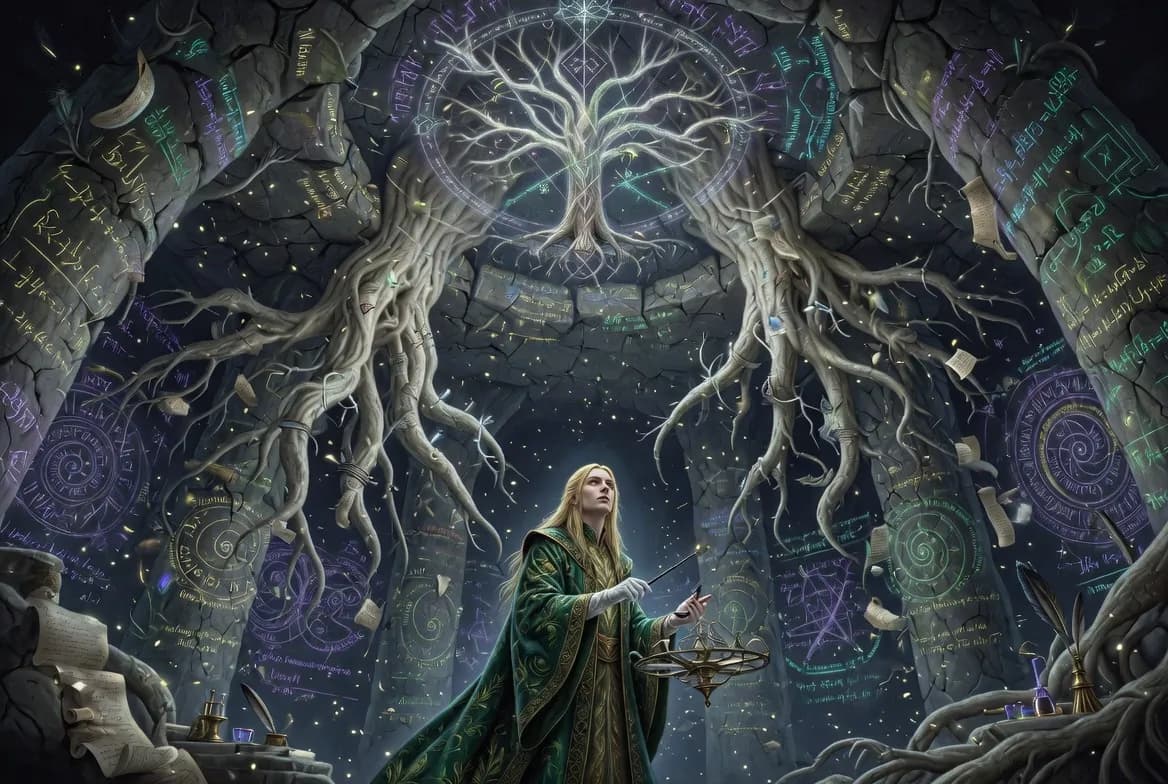
No one knows how to repair them. No one knows how they were built. The creation language that Aethon used to speak them into existence is not fully understood by any living tradition. The Vaelith mages can maintain them, after a fashion, by feeding Resonance into the stones' existing patterns. But maintenance is not repair. Maintenance is slowing the decline. The patterns are degrading, and degraded patterns cannot be restored by pouring more energy into them, any more than a faded painting can be restored by adding more light to the room.
If the network fails, the logistical infrastructure of the Accord's military defense collapses. Reinforcements that currently reach the front in hours would take weeks. Supply lines extend. Response times multiply. The Caesura advances into the gaps.
The Anchor Stones are dying, and no one knows how to save them.
Almost no one.
VII. The Hidden Faith
In basements and back rooms and the quiet spaces between official prayers, the Aethon Seekers are growing.
They are heretics. Every established faith agrees on this, which is notable because the established faiths agree on almost nothing else. The Archonate condemns them as blasphemers who refuse to accept Aethon's withdrawal as divine will. The Concord dismisses them as dreamers clinging to a dead god. The Vaelith scholars consider them amateurs meddling with forces they do not understand. The Grundir Resonance-keepers regard them with the specific contempt that master craftspeople reserve for enthusiastic incompetents.
The Aethon Seekers do not care. They have something that the established traditions do not: results.
Their research into the creation language, fragmentary, dangerous, conducted with more passion than funding, has produced breakthroughs that no official institution can replicate. They have stabilized a failing Anchor Stone. They have purified corrupted soil without military support. They have read fragments of Aethonic script that Vaelith scholars declared untranslatable and found meaning in them. Not complete meaning, not fluency, but syllables. Phonemes. The barest beginnings of a vocabulary in the language that made the world.
They are the only people in Etharia who understand what the Caesura truly is. Not an enemy. Not an invasion. A symptom. The Caesura is what happens when the voice that sustains reality grows too quiet to sustain it. The Blight is not an attack; it is an absence. It is the places where Aethon's word has faded below the threshold required to maintain existence. Fighting the Caesura with swords and Resonance and military formations is not futile, exactly, but it is treating the symptom while the disease progresses. It is bailing water from a boat while ignoring the hole in the hull.
The Seekers believe the hole can be repaired. They believe the voice can be amplified. They believe that somewhere in the ruins of the creation language, in the Aethonic Artifacts scattered across the lost territories, in the degrading Anchor Stones and the damaged Rootsong and the fragments of divine scripture that survived the Breaking, there is enough of the original word left to speak it again. Not as Aethon spoke it; no mortal voice could do that. But loud enough. Clear enough. Enough to push back the silence.
They operate in secret because they must. Their faith is dangerous not because it is wrong but because it implies that every other faith is incomplete. If Aethon is not gone, if he is merely quiet, then the Archons and Archfiends are not the highest powers in the world, and the institutions built on that assumption are built on sand.
The Seekers are few. They are underfunded. They are hunted by the Archonate, monitored by the Concord, dismissed by the academies.
They are also right. And being right, in a world that has organized itself around a comfortable falsehood, is the most dangerous thing a person can be.
VIII. The Gifted
And then there are the ones who come back.
They are called the Gifted, though the name is contested. The Seraphim call them the Aethon-touched, which implies divine purpose. The Korvathi call them the Unfinished, which implies defect. The Vaelith call them Resonance anomalies, which implies that they can be studied. The Arak'thur call them nothing at all, because the Arak'thur have a cultural prohibition against naming things you do not understand, and no one understands the Gifted.
They die. This is established. They fall in battle, they succumb to wounds, they drown and burn and break. Their bodies fail in all the ways that mortal bodies fail. And then, after a period that varies from minutes to hours, they return. Not as ghosts or revenants or echoes or the pale imitations of life that the Caesura produces. They return as themselves, diminished, weakened, but alive. Drawn back from the edge of un-creation by a force that no scholar has been able to identify and no priest has been able to explain.
They are rare. Perhaps one in ten thousand. Perhaps fewer. The mechanism of their selection is unknown. It does not follow bloodlines. It does not correlate with Resonance sensitivity or divine affiliation or racial origin. It simply happens: a person dies, and then they don't. They stand up. They breathe. They remember everything, including the dying, which is a mercy and a cruelty in equal measure.
The Gifted are weapons. The Accord's military commanders understood this immediately. Soldiers who cannot permanently die are of incalculable strategic value. They can be deployed to the most dangerous positions. They can undertake missions that would be suicide for anyone else. They can accumulate combat experience over lifetimes of fighting because the experience is never lost to death.
The Gifted are political assets. Every government wants them. The Accord's charter says nothing about the Gifted because the Gifted did not exist when the charter was written, or if they did, they were too rare to notice. Now they are noticed. Now they are recruited, conscripted, incentivized, threatened, bribed, and fought over by factions that see in their immortality a resource to be claimed rather than a mystery to be understood.
The Gifted are theological puzzles. Every faith has a theory. The Archonate teaches that the Gifted are instruments of divine will, preserved by the Archons to fight the Caesura. The Concord teaches that they are anomalies, cracks in the natural order that the Archfiends tolerate because they are useful. The Vaelith academies hypothesize that the Gifted are resonant echoes, somehow locked into the same frequency as the Anchor Stones, sustained by the same fading infrastructure.
The Aethon Seekers have a different theory.
They believe that the power sustaining the Gifted is not an echo. An echo fades. An echo does not choose. The force that reaches into the moment of a Gifted's death and pulls them back is not a residual vibration in the fabric of reality. It is a decision. Someone, something, somewhere is choosing to bring them back. Choosing each one. Choosing every time.
And choices require a mind.
If the Seekers are right, then the Gifted are not weapons or assets or puzzles. They are evidence. They are proof that Aethon is not gone. Not silent. Not absent. He is there, beneath everything, quieter than he has ever been, fainter with every passing year, but present. Aware. Still making choices about his creation. Still, in this one small and extraordinary way, speaking.
The established faiths reject this interpretation with a vehemence that suggests they are not entirely certain it is wrong.
IX. The Breath Before
This is the world as it exists in the sixty-seventh year of the Accord.
A world of beauty and ruin. Of alliances held together by threat and eroded by self-interest. Of ancient wounds that have never healed and new ones that are still being inflicted. Of an enemy at the border that may be mindless or may be the most dangerous intelligence the world has ever faced. Of an economy balanced on the cooperation of two guilds that are learning to hate each other. Of a divine cold war between immortal powers who have not forgotten their last real war and may be preparing for their next one. Of a refugee nation without a succession plan and a homeland that exists only in memory. Of a secret that could shatter the fragile cooperation between two races whose partnership is essential to survival. Of a fading infrastructure that no one knows how to repair and everyone depends on to function. Of a hidden faith that is producing results that the official faiths cannot explain and will not acknowledge.
Of the Gifted, who die and return, and who no one can explain, and who might be the most important thing in the world or the most dangerous, and who are, in either case, about to become much more numerous.
This is the knife's edge. Not the dramatic kind, not the sword-point of a hero's decisive moment or the climactic choice between light and dark. The knife's edge of a world that has been balanced on a thin line for so long that most people have forgotten they are balanced at all. They go about their lives. They buy bread and sell cloth and pray to their gods and argue with their neighbors and fall in love and grow old and die, and they do not feel the thinness of the line beneath them because the line has been thin for as long as they can remember, and things that have always been true stop feeling dangerous.
But the line is thin. And getting thinner.
The Anchor Stones fade. The Accord frays. The Caesura probes and learns and waits. The Substantiators multiply. The feuds deepen. The bomb ticks. The old jarl grows quiet in her chair by the fire, and the young leave for cities that do not want them, and the mines stay sealed while the ore that could save the world gathers dust beneath mountains that are arguing over who owns it.
And beneath everything, beneath the politics and the wars and the theology and the fear and the ordinary rain falling on ordinary streets, there is a sound.
Not a sound you hear. A sound you are.
It is in the vibration of the Anchor Stones, the ones that still glow. It is in the Rootsong, damaged but not silenced. It is in the moment between a Gifted's death and their return, the infinitesimal pause in which something reaches across an impossible distance and says no, not yet, not this one, not today. It is in the fragments of the creation language that the Seekers study by candlelight in their hidden rooms, mouthing syllables that taste of starlight and deep earth and the first morning of the world.
It is the voice that made everything. It is still speaking.
The scholars say it is an echo, fading. The priests say it is irrelevant, superseded by the gods who inherited the creator's authority. The soldiers say nothing, because soldiers do not have time for theology.
The Aethon Seekers say: listen.
Not with your ears. With the part of you that existed before you were born and will exist after you die, the part that knows, in a place beneath thought and beneath feeling and beneath the long accumulated noise of being alive, that you were made. That the world was made. That making is an act of love, and love does not echo. Love chooses. Love persists. Love is not a sound that was spoken once and is slowly fading into silence.
Love is a voice that is still speaking.
It is just very, very quiet.
And the world, this beautiful, broken, stubborn, fracturing, impossible world, is holding its breath. Waiting to see if anyone is still listening.
Someone is.
You are.
Thus ends the Chronicles of Etharia as they are known. What follows is not written — it is lived, by those who enter the world at the knife's edge and choose, each day, whether to remember or to let the silence win.
The voice is faint. The darkness is patient. The line is thin.
But the candle is still burning.
Select text to add a note.