The Thorn's Return
In which the Dryathi emerge from the deep forests, changed and unforgiving.
"History is the sound the world makes when it remembers what it was. The Caesura is what happens when it forgets. We are the ones who must decide: do we remember, or do we let the silence win?" —Ashk of the Thornborn, Address to the Accord Council, 27 A.R.
For twenty-seven years, the forests held their breath.
Not metaphorically. The rangers who patrolled the timber boundary reported it first: a stillness in the deep woods that went beyond quiet, beyond the mere absence of birdsong or wind. The trees themselves seemed to be waiting. Hunters who ventured past the old Vaelith markers came back with stories of paths that rearranged themselves, of clearings that closed behind you like doors, of the unshakeable sensation that every trunk and root and canopy was watching with an attention that was neither hostile nor welcoming.
Something was healing in there. Something was also breaking.
The Accord Council noted the Dryathi's absence in its charter with a single line: "The seat of the Dryathi remains open, to be filled upon their emergence." "Emergence" rather than "return," because "return" implied they had left. They had not left. They had been driven inward by a psychic wound so vast that the word "wound" is inadequate. What happened to the Dryathi was not an injury. It was an amputation performed on a species that shared a single nervous system.
The Rootsong connected every Dryathi to every other Dryathi. It connected them to the forests, to the rivers, to the slow pulse of the earth's living skin. The scholars who described it as telepathy were always wrong. The Rootsong was more fundamental than thought. It was the substrate of Dryathi consciousness itself. When a Dryathi felt the health of a forest, she was not reading the forest like a book. She was being the forest, temporarily, the way you are briefly the pain when you stub your toe. Not observing it. Not interpreting it. Simply being it, without distance, without the luxury of abstraction.
Seven hundred Dryathi died in a single instant beneath Feladan. Their Rootsong connections did not merely sever; they detonated. The psychic backlash tore through the entire network like fire through a web. Every Dryathi on the continent felt seven hundred deaths simultaneously, experienced through a bond that could not be closed or muted or escaped, because closing the Rootsong would be like closing your own consciousness. You cannot unfeel what you are made of.
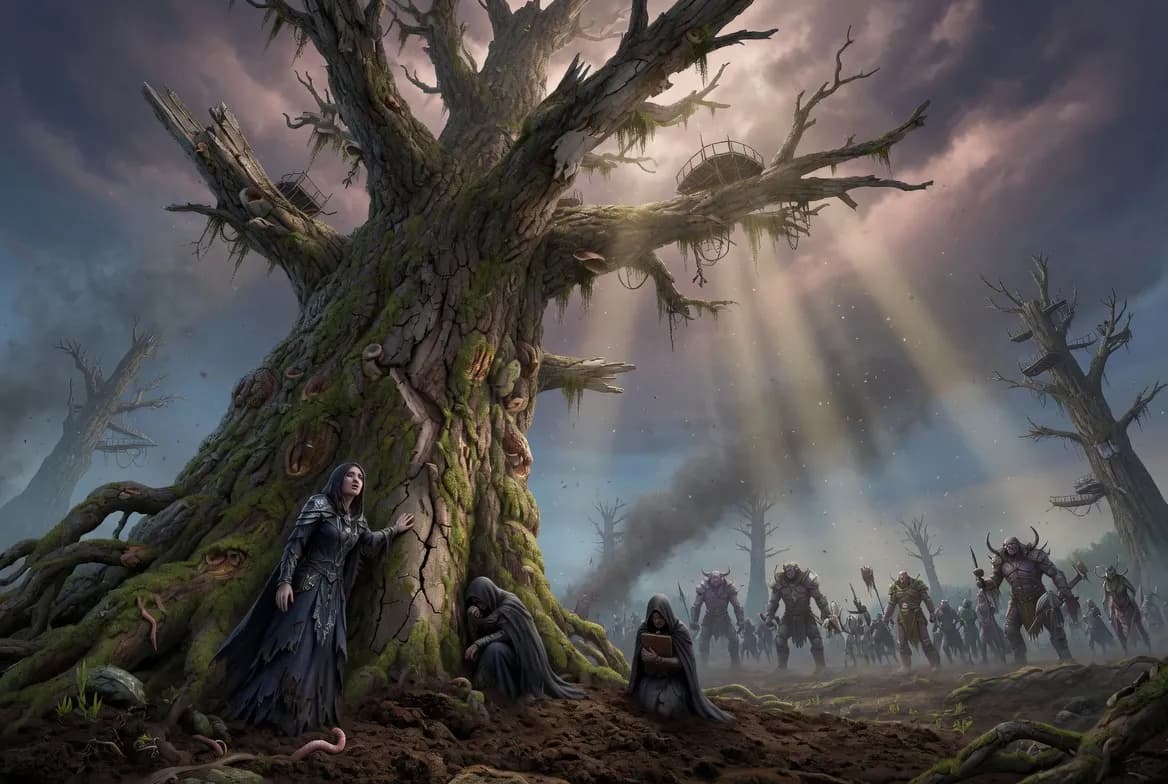
The survivors collapsed. They fell where they stood, screaming, clutching the earth, clawing at their own bark-skin as if they could tear out the dying that was pouring through them. Some did not get up for days. Some did not get up for years. A few did not get up at all, their minds simply refusing to restart. They stood where they fell and slowly, over months, became indistinguishable from the trees around them: rooted, silent, alive in the botanical sense and dead in every other.
The rest went deeper.
The deep forests of Aradoth have no Hearthborn name because no Hearthborn has been far enough inside them to feel the need for one. The Vaelith called them the Virethal, the Living Dark, and even at the height of their sovereignty, even with the Dryathi enslaved and their forests effectively annexed, the Vaelith did not enter the Virethal. It was not forbidden. It was simply understood, the way it is understood that you do not swim into the open ocean: the environment is not hostile, but it is so thoroughly indifferent to your survival that hostility would be redundant.
Here is where the Dryathi went. Into the oldest part of the world's body, where the Rootsong was strongest, where the echo of Aethon's creative voice still hummed in the wood at a frequency too low for mortal ears but perfectly audible to a species that was, in its essence, the living world's awareness of itself.
They went there to heal. They went there to grieve. And they went there to become something else, because the thing they had been—fluid, gentle, trusting—had been used against them so thoroughly that being it again was no longer possible.
The Dryathi who entered the Virethal were one people with two aspects.
The Thornborn and Bloomborn were not castes or subspecies or political factions. They were moods. A Dryathi might spend a season as Thornborn, fierce and protective, bark hardening, thorns extending, and then shift into Bloomborn: open, creative, flowers budding, consciousness expanding outward. The oscillation between the two was the rhythm of a whole life, and the Rootsong facilitated it, carrying the mood of each individual through the network so that the community shifted together, a forest of selves breathing in and out in time.
The binding broke that rhythm. For two hundred years, the Dryathi were kept in permanent Bloomborn compliance: gentle, yielding, their thorns suppressed by the same magic that hijacked the Rootsong. The fury that should have risen in them was blocked. Dammed. Two centuries of unexpressed rage, accumulating like pressure behind a wall.
When the binding shattered, the wall shattered with it. Two hundred years of compressed fury releasing at once, into a network simultaneously processing seven hundred deaths.
The Dryathi who entered the Virethal were broken. The Dryathi who emerged, twenty-seven years later, were not repaired. They were remade. And the remaking had a cost.
The shift stopped.
The simplest way to say it, and the most terrible. The Thornborn stayed Thornborn. The Bloomborn stayed Bloomborn. The fluid, seasonal rhythm that had defined Dryathi existence since the world's first forests—the breathing in and breathing out, the winter self and the spring self, the wholeness that came from containing both—hardened into permanence, like a river freezing and never thawing.
The Rootsong still functioned. But it was damaged, scarred, like a voice that had screamed until it went hoarse. Where it had once carried the full spectrum of Dryathi experience, it now carried only echoes of its former range. A Thornborn could feel the Bloomborn through the song, could sense their gentleness and their grief, but could not become it. Could not cross the gap that had opened in the song's damaged frequencies, any more than a hoarse voice can reach the notes it once sang easily.
The Bloomborn felt the Thornborn's rage and understood it and were terrified by it. Not because it was alien, but because it was familiar. It was their own rage, the rage they would have expressed if the song had not scarred in a way that locked them into gentleness. Gentleness was their scar tissue. It protected them from the wound beneath.
The Thornborn were fierce with the compressed fury of two centuries of enslavement. Not hot fury, not the explosive rage that spends itself in violence and then cools. Cold fury. Dense fury. Fury that had been compressed into something diamond-hard and diamond-sharp, fury that did not dissipate because it was not a feeling anymore. It was a structure. It was the architecture of their identity, the bones of who they were, and you cannot relax your bones.
They were not angry at the Vaelith. Anger is temporary. What the Thornborn felt was the settled, geological conviction that a wrong had been committed that had not been acknowledged, and until it was acknowledged, the wound would not close, and until the wound closed, the song would not heal, and until the song healed, the Dryathi would never be whole again.
Justice. Not revenge. And they knew, with the clarity of a people who feel truth in their roots, that they were not going to get it.
They emerged on the first day of spring, 27 A.R.
The symbolism was noted by every chronicler and missed by most of them. Spring was Bloomborn season, the time of opening, of growth, of the generous outward expansion that had once characterized the whole species. That the Dryathi chose this day was a statement: We remember what spring meant. We are telling you that we are not that anymore.
Three hundred and twelve Dryathi walked out of the Virethal's northern edge. The farmers who saw them first did not immediately understand what they were seeing. The Dryathi had changed physically as well as psychically. The Thornborn were darker, their bark deepened from living wood-brown to something closer to ironwood black, dense and faintly metallic, with thorns that had once been seasonal defensive features now permanently extended along their arms, shoulders, and the ridges of their skulls. Their eyes, which had always shifted between the warm amber of Bloom and the pale green of Thorn, were fixed now: winter-green, sharp, unblinking.
The Bloomborn were paler. Their bark had lightened to birch-white and silver, and their flowers, which had once bloomed in every color the forest could produce, now bloomed only in white. Not the warm white of apple blossoms. A cold white. The white of bone. The white of snow that falls on graves.
They walked in formation. Not military formation—the Dryathi had never been warriors in any conventional sense—but harmonic formation, arranged in patterns that reflected the damaged Rootsong's remaining frequencies. The Thornborn at the edges. The Bloomborn at the center. Between them, a visible gap. Not physical distance, but something you could see in the way they oriented toward each other, always aware, always connected, yet no longer able to close the space between what they were and what they had been.
A Kithara scout named Vel Brighteye was the first official representative of any race to make contact. She later wrote:
"I have seen the Blight. I have seen what it does to land and life and the space where meaning used to be. I thought that was the worst thing in the world. Then I saw the Dryathi walking out of the forest, and I understood that there is something worse than destruction. There is survival that costs so much that the survivors are not sure they are glad to have survived."
The delegation arrived at Talor three days later. The Accord Council was convened in emergency session. The chamber, the same hall in Talor's citadel where the original Accord had been hammered out twenty-seven years earlier, was filled to capacity. Every signatory race had representatives present. The air smelled of lamp oil and nervous perspiration.
The Vaelith delegation occupied their usual seats at the curved table's western arc. House Aelindra had sent Lord Caelith, a diplomat of considerable skill and equally considerable ability to say nothing while appearing to say a great deal. House Veylith had sent a young archivist named Sylaera, a junior functionary, which meant Veylith wanted plausible deniability for whatever was about to happen.
Arbiter Corren, a Talor judge with a reputation for procedural fairness, sat at the head of the table with a gavel he hoped he would not need. The Tesseri delegation consisted of a single factor named Pip, taking notes in a shorthand no one else could read.
The Vyssari elder Thesska had positioned herself at the table's eastern curve, her vertical-pupiled eyes moving slowly across the room. The Ancestral Current would preserve this moment for every Vyssari who came after.
The Seraphim had sent a Luminar named Brother Aldren, wings folded tight in the configuration of solemn witness. The Korvathi had sent a Dusk Warden named Senn, who leaned against the far wall and watched the Vaelith with an expression that could have been contempt or amusement or both.
The Dryathi entered the chamber through the eastern door, and the room changed.
Not physically. The walls did not move. The lamps did not dim. But everyone present later reported the same sensation: a shift in the air, a sudden density, as if the room's atmosphere had thickened with something adjacent to sound and adjacent to emotion but identical to neither. The Rootsong. Damaged, scarred, operating at a fraction of its former range, yet still powerful enough that even non-Dryathi could feel it pressing against the edges of their perception like a sound just below the threshold of hearing.
Twelve Dryathi entered. Eight Thornborn and four Bloomborn. The Thornborn moved with a controlled precision that defied easy categorization—part military, part graceful, part threatening, all three at once. The movement of beings who had learned to keep their bodies very still because the alternative was to let the fury move through them, and the fury, if it moved, might not stop.
The Bloomborn moved like apologies. There is no better description. Their steps were soft, their posture open. But beneath the openness was something brittle, the composure of someone who has decided that composure is the only thing standing between them and a collapse they cannot afford.
At their center was Ashk.
She was Thornborn. Five and a half feet, with ironwood-dark bark and permanent thorns and eyes the color of deep winter ice. She wore no ornament. She carried no weapon. She had a voice, and she had a memory, and she had walked out of the Virethal carrying both of them like stones she had chosen not to put down.
The Dryathi delegation took the open seats at the table's southern arc, the seats that had been empty for twenty-seven years, maintained and cleaned each session by Talor's custodial staff with the quiet stubbornness of people who believe in setting places for the absent.
Arbiter Corren cleared his throat. "The Accord Council recognizes the delegation of the Dryathi people. We have received your petition for formal inclusion—"
"The Vaelith delegation wishes to speak," Lord Caelith interrupted.
Corren looked at the Dryathi delegation. Ashk inclined her head. A fraction. Permission granted with the minimum possible motion.
Lord Caelith stood. He was tall, golden-haired, with the fine-boned elegance that the Vaelith wore like inherited armor. He held a scroll. He did not need it—the words were memorized—but the scroll was a prop, a signal that this was an official statement, reviewed and approved by his house's senior counsel.
"On behalf of the Vaelith people," he began, "and in particular on behalf of House Aelindra, which has borne the responsibility of Vaelith governance since the Breaking, I wish to address the Dryathi delegation directly."
He turned to face the Dryathi. His expression was calibrated to the precise degree of solemnity that diplomatic protocol demanded: grave enough to signal sincerity, open enough to suggest vulnerability without actually being vulnerable.
"The Vaelith acknowledge the suffering of the Dryathi people. We acknowledge that the binding of the Rootsong, undertaken during the reign of King Aeloran, constituted a profound injustice. We acknowledge that the consequences of Aeloran's ritual were catastrophic, for the Dryathi and for all the peoples of Aradoth. And we express our deepest regret for the role that Vaelith actions played in causing that suffering."
He paused. The pause was timed. Caelith was good at his craft.
"The Vaelith of today are not the Vaelith of Aeloran's reign. We offer the Dryathi our hand in partnership — not as former masters, but as fellow survivors of a catastrophe that harmed us all."
He sat down. The scroll remained on the table, displayed.
It was a good speech. Structurally flawless. It acknowledged suffering without specifying it. It expressed regret without accepting responsibility. It referenced Aeloran by name, allowing the dead king to absorb the blame like a shield held up by someone standing safely behind it. And it pivoted, with practiced efficiency, from the past to the future, from what was done to what will be done, without lingering in the present, where the question of what is owed might be asked.
It was, in short, the kind of apology that is composed by lawyers and delivered by diplomats and understood by everyone in the room to mean: We are sorry this happened. We are not sorry for what we did. We are sorry you are here, reminding us.
Ashk did not move.
She sat in her chair with her hands flat on the table—dark bark against polished wood, the irony of which no one mentioned—and she looked at Lord Caelith with an expression that was none of those expected things: not anger, not contempt, not sorrow. It was the place where all three meet and cancel each other out, leaving something harder and more permanent than any of them.
She said nothing.
The silence lasted. Five seconds. Ten. The kind of silence that starts as a pause and becomes a presence, occupying the room the way smoke fills a room, pressing against every surface, making it difficult to breathe. Not because there is less air, but because the air has become aware of you and is waiting.
Fifteen seconds. Arbiter Corren's hand moved toward his gavel. He stopped himself. You do not gavel away a silence that has earned its place.
Twenty seconds. Lord Caelith's composure held, but the muscles in his jaw tightened. Sylaera was looking at the table.
Thirty seconds. Pip's stylus had stopped moving. Thesska's eyes were fixed on Ashk with the stillness of a Vyssari witnessing something she knew the Current would carry forward for a thousand years.
Ashk spoke.
"You bound our minds."
Four words. She did not raise her voice. The Rootsong carried her words into the room's silence like stones dropped into still water, and every person in the chamber felt those words not just in their ears but somewhere deeper, in the place where you know things before you understand them.
"You used our bodies."
Second stone. The ripples from the first had not yet reached the walls.
"You killed seven hundred of us in a ritual that broke the world."
Third stone. The water was no longer still.
"And now you offer words."
The silence that followed was different from the one before. The first silence had been anticipatory, a held breath. This silence was structural. It was the silence of a room that has heard something true and does not know how to resume being a room where things are negotiated and compromised and smoothed over, because the truth has changed the room's architecture, and the old furniture no longer fits.
It lasted, by multiple accounts, for over a minute. No one spoke. Several delegates later reported that the air seemed to change temperature. Not warmer or colder, but denser, as if the atmosphere itself was bearing witness.
Brother Aldren's wings shifted. A single feather drifted to the floor. Seraphim shed feathers under emotional stress. Senn the Korvathi had stopped leaning against the wall. His expression had changed from amused contempt to something more complicated.
Lord Caelith sat very still, looking at a point just to the left of Ashk's face, the way you look at the sun's reflection in water because you cannot look at the sun itself.
Ashk continued.
"We will join the Accord."
The shift in the room was immediate, a collective exhale, the beginning of relief. Corren's hand relaxed on the gavel.
"Not because we forgive."
The exhale stopped.
"Because the world is dying and we feel it dying in our roots and our blood and our children's dreams. We will fight the silence that is eating the song. We will fight alongside the people who enslaved us, and the people who let it happen, and the people who are already forgetting. We will fight because if we don't, there will be no world left to fight for."
She paused. Not for effect. She paused because what she was about to say was heavy, and she needed to hold it properly before she set it down.
"But we will not forget. And we will not forgive. Not until the truth is spoken."
She was looking at the Vaelith delegation. Not at Caelith but past him, through him, to the seat where Sylaera of House Veylith sat with her ink-stained fingers and her archives full of sealed rooms.
House Veylith's representative did not meet her eyes.
The vote was unanimous. The Dryathi were granted their seat. The Thornheart, the territory they had claimed in the Virethal during their twenty-seven years of seclusion, was recognized as sovereign Dryathi land. The charter was amended. The signatures were affixed. Pip charged three silver for a copy of the transcript and five for the annotated version.
The relationship between the Vaelith and the Dryathi was officially listed as "cordial."
Everyone at the table knew what "cordial" meant.
It meant the wound was sutured but not healed, and the sutures were made of lies.
Lord Caelith returned to the Vaelith delegation's quarters that evening and wrote a letter to House Aelindra's High Council. The letter, later recovered from the Aelindra archives, contained a single substantive observation amid three pages of diplomatic boilerplate:
"The Dryathi representative used the phrase 'until the truth is spoken.' She was addressing House Veylith specifically. I believe she knows, or suspects, the nature of the sealed records. If the truth she is requesting is the truth I believe it is, its emergence would be catastrophic — not merely for Vaelith-Dryathi relations, but for the structural integrity of the Accord itself."
He did not specify what truth. He did not need to. Every senior Vaelith knew what was in the sealed archives. The Dryathi had not been accidental casualties of a failed experiment. They had been deliberate components of a ritual that required their suffering to function. The binding had been undertaken not despite the cost to the Dryathi but because the cost was the point. Broken wills channel Resonance more efficiently than whole ones. The slavery was the first phase of the ritual, extended over two hundred years.
This was the truth that Ashk was asking for. This was the truth that House Veylith had sealed behind locked doors and blood-oaths and the careful, patient, institutional project of making the world forget.
Ashk served as the Thornheart's ambassador to the Accord Council for twelve years before stepping down, citing not exhaustion but clarity: I have said what I needed to say, and I will not repeat it, and you will either hear it or you won't.
She was replaced by a Bloomborn named Thessaly, whose diplomatic style was gentler, more patient, more willing to engage in the incremental compromises that institutional politics demanded. The Accord Council was relieved. Thessaly was easier. Thessaly did not make the air change temperature when she spoke.
But every spring, on the anniversary of the Dryathi's emergence, the Thornheart sent a single message to the Accord Council. Unsigned. Unadorned. Containing four words that no one on the Council discussed publicly and no one on the Council forgot:
The truth remains unspoken.
And every spring, House Veylith's representative received the message, and filed it, and said nothing.
And every spring, the sutures held.
But sutures made of lies do not hold forever. They hold until the wound beneath them decides it is tired of being sutured.
The Dryathi understood patience. They had been the forest's awareness of itself, once, and forests think in centuries. They were waiting still.
"Do not ask me if I hate the Vaelith. Hate is a fire, and fire burns out. What I carry is not fire. It is soil. It is the ground itself, remembering what was planted in it and what was torn from it and what grew in the place where the torn thing used to be. The ground does not hate the farmer who salts it. The ground simply refuses, forever, to pretend that the salt was rain."
—Ashk of the Thornborn, private correspondence, undated
Select text to add a note.