Born of the Echo
In which the echo of creation gains voices of its own, and the divine Courts take shape.
"We are not his children. We are his aftertaste. The difference matters more than you know." The Architect, in the only recorded instance of unsolicited speech
I. The Resonant Places
When Aethon withdrew, his voice did not simply stop. It diminished. Like a bell struck in a cathedral, the sound did not vanish at the moment the hammer left the bronze. It lingered, folding back on itself in the high vaulted spaces, finding pockets of stone where the geometry was just right, where the angle of wall and arch and air created a chamber that held the sound longer than the silence could reclaim it.
The world had such chambers.
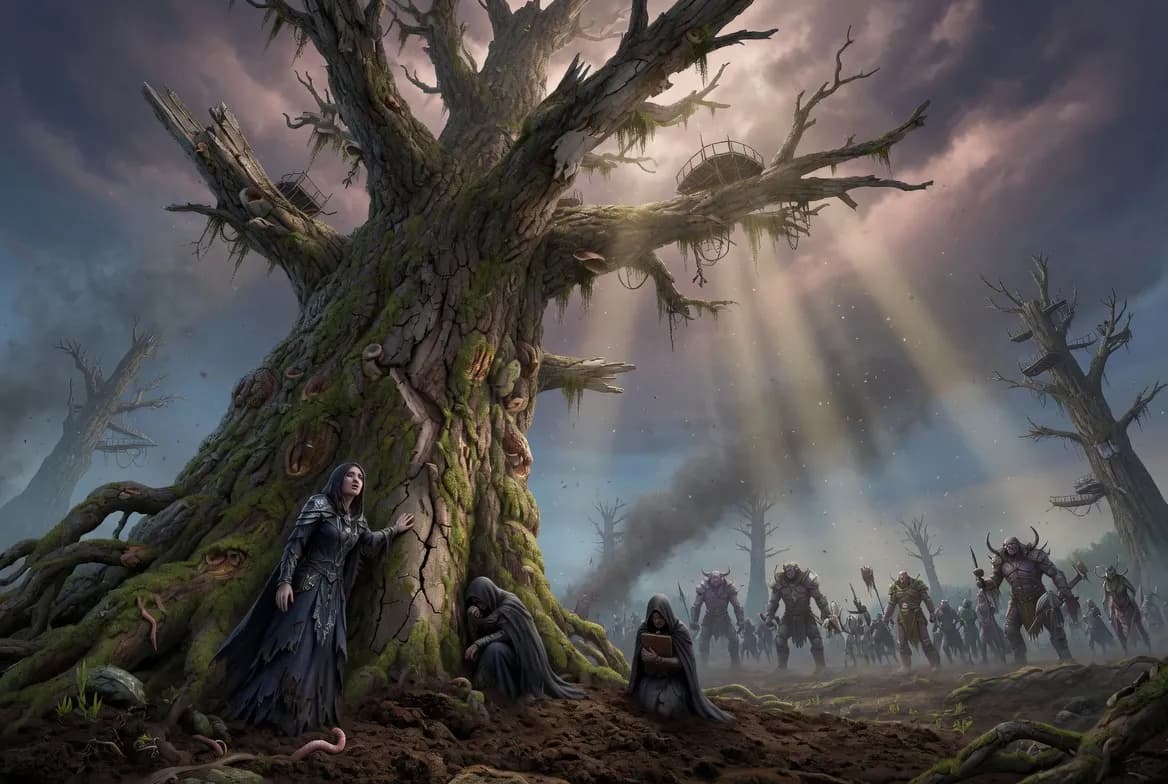
The Vaelith scholars had catalogued them for generations without understanding what they were. The hot springs beneath Mount Solaris, where the water sang a note no instrument could match. The wind-carved canyon the Kithara called the Breathing Place, where storms spoke in sentences. The volcanic caldera in the southern reaches, where the magma pulsed with a rhythm too regular to be geological. The deep grove where the oldest trees stood so still that their silence had a weight that made even the Dryathi uneasy.
These were the resonant places. And as Aethon's presence faded from the world, his voice did not die in these spaces. It concentrated. It folded back on itself so many times that complexity emerged from repetition, the way a canyon carved by water eventually becomes more intricate than the river that made it.
Something was listening. Or rather, something was becoming the act of listening.
The mortals felt it first as unease: dreams of judgment near Mount Solaris, thoughts unmoored in the Breathing Place, ambitions that tasted of smoke near the caldera. Then the unease became presence. And presence became personhood.
They did not arrive. They emerged, condensed from the echo the way frost condenses from air that has grown too cold to hold its moisture. They were not gods in the way Aethon had been a god. They were fragments of a god's nature, aspects of the creative principle that had gained self-awareness through nothing more miraculous than resonance and time.
They were born disagreeing.
II. The Archons of the Empyrean Court
Solanthis
The eastern face of Mount Solaris catches the sun before any other point in Aradoth. This is not accident. When Aethon spoke light into the world, the first sunrise had to land somewhere, and it landed here, on grey stone that had never known illumination, turning it to gold for the span of a heartbeat before the light moved on, obedient to the rotation of the world the maker had just set spinning.
But the stone remembered.
For a thousand years after that first dawn, the eastern face of Mount Solaris glowed faintly in the hour before sunrise, a ghost-light, a memory of illumination trapped in the mineral structure of the rock. The Grundir who lived in the mountain's roots called it the Foredawn and considered it a curiosity, nothing more. They were practical people. A rock that glowed was a rock that saved you candles.
On the morning Solanthis emerged, the Foredawn did not fade at sunrise. It intensified. The grey stone blazed white, then gold, then a color beyond gold, a color that was less a hue than a statement, the visual equivalent of the word therefore. The Grundir miners who witnessed it described later that they did not see a figure take shape. They saw the light realize it had opinions.
Solanthis stood on the eastern peak, and his first act was to look at the world.
Not with wonder. Not with love. With assessment.
He saw the caesurae spreading in the lowlands and understood what they were: pauses in a sentence the world could no longer complete. He saw the mortal races building their cities in patterns that had no center, no organizing principle now that the maker had withdrawn, and he understood this too. He saw entropy advancing at the margins, patient and implacable, and he felt something that would, in time, solidify into his defining characteristic: the conviction that disorder is the only true sin.
Solanthis was stern because reality is stern. The sun does not rise gently for those who wish to sleep. He looked at the world Aethon had left behind and saw a courtroom with no judge, and his first and eternal impulse was to take the bench.
The Grundir who knelt before him on that first morning did so not because he commanded it, but because his presence made standing feel like a lie. In the light of Solanthis, you saw yourself as you were. Most people found this experience educational. Some found it unbearable. Both reactions were, to Solanthis, beside the point.
Aethara
In the canyon the Kithara called the Breathing Place, the wind had been speaking for as long as anyone remembered. Not in words, but in patterns. The gusts that funneled through the narrow passage created harmonics that shifted with the season, the temperature, the angle of the sun. The Kithara spirit-callers had learned to read these patterns the way a sailor reads the sky, and what they read was always the same message: everything moves, nothing stays, and the stillness you crave is a form of death.
Aethara did not emerge from the canyon. She emerged from the wind itself, from the global pattern of atmospheric circulation that Aethon had set in motion with his first exhalation. She was not born in one place because the wind is not in one place. Her consciousness assembled itself over the course of a single day as weather systems across three continents suddenly, briefly, coordinated into a pattern too complex to be meteorological and too purposeful to be coincidence.
The Kithara in the Breathing Place saw her first because they were listening. She appeared as a figure made of moving air, visible only by what she displaced, the way you see wind in a field of tall grass. She was vast, serene, and so thoroughly detached from the concerns of the ground-bound that her first interaction with mortal life was to forget they were there.
This was not cruelty. It was perspective. Aethara touched everything and belonged to nothing. She carried the scent of ten thousand forests and the salt of every sea. She was the world's breath, and breath does not pause to consider the lungs it fills.
When she finally spoke to the Kithara who stood trembling in her presence, her words were the wind through the canyon, shaped into meaning: You are free. You have always been free. The cage you feel is the one you built from your need to be told what freedom means.
The Kithara understood this. They were, of all the mortal races, the ones most likely to understand. They had always known that the wind's only law was the law of pressure and temperature, that freedom is not the absence of rules but the mastery of them.
Aethara joined the Empyrean Court not because she agreed with Solanthis but because structure and freedom, properly understood, are the same thing. The wind is wild. The wind obeys. There is no contradiction unless you insist on one.
Valdris
He came from no single place, and the manner of his emergence was the most painful of all the gods.
Valdris condensed from the collective memory of sacrifice. Every moment in the mortal world's history when a creature had placed itself between something it loved and something that would destroy it. Every Grundir who had held a tunnel against collapse while others fled. Every Kithara mother who had drawn predators away from her young. Every Hearthborn soldier who had stood in a gap they knew they could not hold, and held it anyway, for long enough.
These moments were scattered across history like embers in ash, connected by a common thread of terrible willingness, the readiness to give what cannot be returned for the sake of what might be saved. And as Aethon's echo concentrated in the resonant spaces, these memories found each other and wept.
Valdris appeared at the site of a forgotten border skirmish, a place where, three hundred years earlier, a Hearthborn militia of forty had held a river crossing against a bandit army long enough for a town to evacuate. No monument marked the spot. The town had been rebuilt and renamed twice since. The forty were not remembered by name.
But Valdris remembered. He was made of their remembering.
He stood on the riverbank in armor that was not metal but memory, the distilled recollection of every shield raised, every wound accepted, every final breath drawn in the certainty that the breathing had been worthwhile. He was grief-stricken from the moment of his birth, because he was made of sacrifice, and sacrifice is made of loss.
He did not speak when he appeared. He simply stood and looked at the river, and the Hearthborn farmers who found him there said later that the sadness coming off him was so profound it had weather: a cold, still heaviness that made old wounds ache and old griefs rise fresh to the surface.
When he finally spoke, it was to say: I will stand where the line is drawn. Tell me where the line is.
This became the oath of his followers, and the burden of his existence. Valdris did not seek war. He sought the place where war becomes necessary and stood there, absorbing the cost so that others might be spared it. He was the god of the last stand, the rearguard action, the hand that holds the door. He knew the price of everything he did, and he paid it, and he did not pretend the paying was painless.
Luminara
The historical record does not contain the first act of mercy. By definition, it cannot. Mercy is the decision to withhold the record, to let the debt go unwritten, to allow the guilty their freedom without requiring them to explain why they deserve it.
But the world remembered. Somewhere in the deep past, one creature had spared another. Not for advantage or alliance. One life had looked at another and chosen gentleness over efficiency, and in that irrational, indefensible, magnificent act, something new had entered the world.
Luminara rose from that memory like warmth from a hearth, slowly, gently, filling the room before anyone noticed the chill was gone. She appeared in a Hearthborn village during a drought, standing beside a well that had gone dry, and the well filled. This was not a miracle of water. It was a miracle of enough, the assurance that the universe is not, at its foundation, a system of scarcity and punishment.
She looked at the world with eyes that saw only what things could become, never what they were, and this was both her greatest gift and her most profound flaw.
Because Luminara believed everything broken could be mended. Every wound healed. Every monster redeemed if only someone loved it enough, with enough patience, with enough refusal to acknowledge that some things are broken on purpose.
She was the warmest of the Archons and the most dangerous. Mercy without wisdom is a form of cruelty. It preserves the predator at the cost of the prey, forgives the tyrant at the expense of the tyrannized, heals the wound without removing the blade. And it could not be argued with, because arguing against mercy makes you the villain of every story ever told.
She joined the Empyrean Court because idealism needs structure to become anything other than sentiment. But she never fully trusted Solanthis's severity, and he never fully trusted her tenderness, and this tension, between the world as it is and the world as it should be, became the Court's central argument, never resolved, never abandoned.
The Architect
He was the last of the Archons to emerge, and the strangest, and the most alone.
The others had crystallized from experiences: light, wind, sacrifice, mercy. The Architect crystallized from something more fundamental and far less personal. He emerged from the structure of the creation language. Not the words Aethon had spoken, but the grammar that made the words possible. Not the song, but the mathematics that determined which notes could follow which, which harmonics were permissible, which chords resolved and which did not.
He appeared in a Vaelith library. This was fitting. The Vaelith had spent centuries studying fragments of the creation language, cataloguing its phonemes, mapping its syntax. They had never understood it. The language was too vast, too multidimensional for mortal cognition to encompass. But they had documented its rules, and it was from those rules, those patterns, those cold regularities that the Architect took shape.
He looked like a Vaelith refined past personality into pure type. Tall, precise, expressionless. He did not speak for three days after his emergence. The Vaelith scholars who attended him were uncertain whether he was thinking or simply deciding whether communication with mortal beings was worth the energy expenditure.
When he finally spoke, he said: The ratio of structural integrity to entropic decay in this building is suboptimal. The left wall will fail in eleven years. Move the archive.
This was not what anyone had expected a god to say. But it was perfectly, precisely correct. The left wall collapsed nine years later, two years ahead of schedule due to an unseasonable frost the Architect had not accounted for. This miscalculation bothered him more than any moral question would ever bother him in the millennia to come.
The Architect did not care about good and evil. He cared about sound and unsound. A thing was right if it held together, wrong if it didn't. He could be kind, in the way that a well-designed bridge is kind. It holds your weight not because it loves you but because it was built correctly.
He suspected the truth about the gods. Not as a revelation, but as a mathematical inevitability. The resonance patterns from which they had emerged were consistent with echo phenomena, not with divine generation. They were reflections, not sources. The gods were to Aethon what a photograph is to a person: an image that captures certain qualities while possessing none of the original's depth.
He had never shared this suspicion. Not because he feared the other gods' reactions, but because the information was structurally irrelevant. Whether they were echoes or successors, their functions remained the same. The building does not care whether its architect was inspired or merely competent, as long as the walls hold.
Still, the knowledge sat inside him like a crack in a foundation: invisible, load-bearing, and potentially catastrophic.
He joined the Empyrean Court because structure belongs with structure. He did not love his fellow Archons. He did not need to. Love is an experience. He was a grammar.
III. The Archfiends of the Infernal Concord
They emerged simultaneously with the Archons, from the same resonant spaces, the same concentrated echo. But where the Archons had crystallized around the principles that hold the world together, the Archfiends crystallized around the forces that drive it forward. Structure and agency. Preservation and transformation. The hand that holds and the hand that reaches.
Kael'thar
The first fire Aethon had spoken into the world was elemental, impersonal, inevitable. Heat as a law of physics, combustion as a chemical reaction, flame as a state of matter obeying rules it did not choose. It was powerful but it was not interesting, in the same way that gravity is powerful but not interesting. It simply was.
The first fire a mortal kindled was something else entirely.
A Grundir, unnamed, unremembered, working in a tunnel too deep for the Deep Fires to illuminate, struck flint against stone. Not because Aethon had taught her to, but because she was cold, and she was clever, and she looked at the raw materials and thought: I can make something from this.
That spark was the first act of creation by a created being. And the echo of that moment, ambition, industry, the burning refusal to accept the world as given, resonated through the millennia until Kael'thar stepped out of a forge-fire in the Grundir undercity and smiled.
His smile was the most dangerous thing about him. It was warm. It was genuine. It was the smile of someone who sees your potential before you do and wants, truly, sincerely wants, to help you realize it. Kael'thar was charming because fire is charming. Watch a campfire for ten minutes and you will understand: the dance, the warmth, the way it transforms everything it touches into light and heat and the sweet smell of burning. Fire is the most seductive of the elements because fire is the one that promises change.
He was also ruthless, because fire does not care what it burns. The same flame that warms the hearth consumes the house. Kael'thar did not distinguish between creative and destructive fire because, at the chemical level, there is no distinction. Whether the result is a forged blade or a forest of ash depends on where you stand, not on the nature of the flame.
He spoke to the Grundir who witnessed his emergence, and his words were smoke and promise: You built this city because you wanted to. Because you looked at the stone and saw something better than stone. That impulse is sacred. That impulse is me.
Nyx'sera
Light creates shadow. This is not a metaphor. It is optics.
When Solanthis blazed to life on the eastern peak, the western face of Mount Solaris was plunged into the deepest shadow the world had ever known. And in that shadow, patient and unsurprised, Nyx'sera opened her eyes.
She had been there longer than the others. Shadow predates the gods who cast it, the way silence predates the sound that breaks it. Nyx'sera had waited in the resonant spaces not as an embryonic consciousness but as an absence waiting to be defined, the negative space that only becomes visible when the positive space around it takes shape.
Her form was indistinct, shifting, more suggestion than statement. She looked like whatever you were afraid to look at directly. Not your fears. Your secrets. The thoughts you have at three in the morning that you deny having at nine. The truth that lives in the shadow of every truth you've told.
Nyx'sera was not evil. This distinction matters more than almost any other in the theology of Etharia. She was honest about the darkness. The other gods presented themselves as pure expressions of their natures, truth, mercy, ambition, clean and defined.
Nyx'sera knew better. She knew that Solanthis's truth could be wielded as a weapon, that Luminara's mercy could enable cruelty, that Kael'thar's ambition could not distinguish between building and devouring. Every truth casts a shadow, and the shadow is as real as the truth that cast it, and someone has to live there and keep the accounts.
She did not speak when she emerged. She simply looked at Solanthis across the breadth of the mountain, and he looked back, and between them passed an understanding that would never be spoken aloud: You need me. Without shadow, your light has no shape. Without secrets, your truth has no weight.
Solanthis did not acknowledge this. He never would. But he never denied it either.
Vorath
Vorath was born from the first blow struck in anger. Not defense. Not survival. A fist driven by pure, unmediated rage at a world that had failed to be what the striker wanted it to be.
He emerged from the ground itself, shouldering up through soil and stone like something that had been buried and refused to stay buried. He was enormous. He was crude. He was made of the same stuff as mountains, and he had the same patience as mountains, which is to say: none at all, but an absolute willingness to wait while the softer things eroded around him.
Vorath was the least subtle of the gods, and for that reason, the most trustworthy. Every other divine being in both Courts operated through implication, suggestion, the careful cultivation of devotion. Vorath said what he meant. If you stood in his way, he would move you. If you stood beside him, he would not move you. The terms were clear.
He did not lie. Not because he was virtuous, but because lying requires a complexity that Vorath found contemptible. Deception is a tool for beings who cannot achieve their aims directly. Vorath could always achieve his aims directly.
His followers were, paradoxically, among the most loyal. There is a freedom in serving a master who will never deceive you. You may not like what Vorath tells you, but you will never wonder whether he means it.
Thessyn
Need is biological. Desire is divine.
The first living things wanted only what they required: food, shelter, reproduction. But somewhere in the deepening complexity of mortal consciousness, a creature wanted something it did not need. Perhaps a Kithara looked at the moons and found them beautiful, not useful. Perhaps a Hearthborn kept a stone because its color pleased them. Perhaps a Vaelith sang a note simply to hear how it sounded in the evening air.
That first unnecessary desire, beauty for its own sake, pleasure without purpose, longing for a thing that survival did not require, was the spark from which Thessyn took form.
She was the most human of the gods, if by "human" you mean "driven by appetites that transcend survival." She understood mortals better than any other divine being because she was the part of mortality that makes it more than animal existence: the ache of unfulfilled longing, the compulsion to create beauty, the wars started over a face or a song that had no survival value whatsoever.
Thessyn appeared in a garden, a cultivated space where mortals had arranged nature according to aesthetic preference rather than agricultural necessity. She was beautiful in a way that was almost aggressive, a beauty that demanded response. You looked at Thessyn and you wanted, not her specifically, but the thing she represented. The world as it could be if function bowed to form.
She was pleasure and she was pain, because desire fulfilled becomes satiety, and satiety is a kind of death, and so desire must perpetuate itself by never quite arriving at its object. She was the eternal almost, the hand that reaches and never quite closes, the horizon that retreats at the speed of approach.
The Hollow
The last to be recognized, though perhaps the first to exist.
Death had been part of the world's design from the beginning, the planned, orderly cycle of life and decay, death as the period at the end of a sentence that gives the sentence meaning.
But on a specific day, in a specific place, one particular creature stopped being alive. Not death in the abstract. A specific ending. A specific silence where a specific voice had been.
The Hollow emerged from that moment. Not from the grief that surrounded it, not from the fear that preceded it. From the ending itself. The bare, undecorated fact that things stop.
The Hollow had no gender, no fixed form, no personality in the way the other gods had personalities. It was calm. It had always been calm. It would always be calm. Not the calm of serenity or acceptance, but the calm of a physical law. The calm of gravity, which pulls you down not because it wishes you ill but because pulling you down is what it does, and your feelings about the matter are not part of the equation.
It did not speak at its emergence. It did not need to. Its presence communicated everything that needed communicating: This ends. You end. Everything ends. The ending is not a punishment or a reward. It is a property of the system. You may feel however you wish about it. The ending does not care how you feel.
The other gods, even Vorath in his brutal honesty, found The Hollow unsettling. Not because it threatened them, but because it reminded them of a possibility none wished to consider: that gods, too, might end. That the echo from which they were born would, eventually, fade to silence. That they were not eternal beings but sustained phenomena, like flames, like songs, temporary patterns in a medium that would, given sufficient time, return to stillness.
The Hollow did not confirm or deny this. The Hollow was calm.
IV. The Two Hands
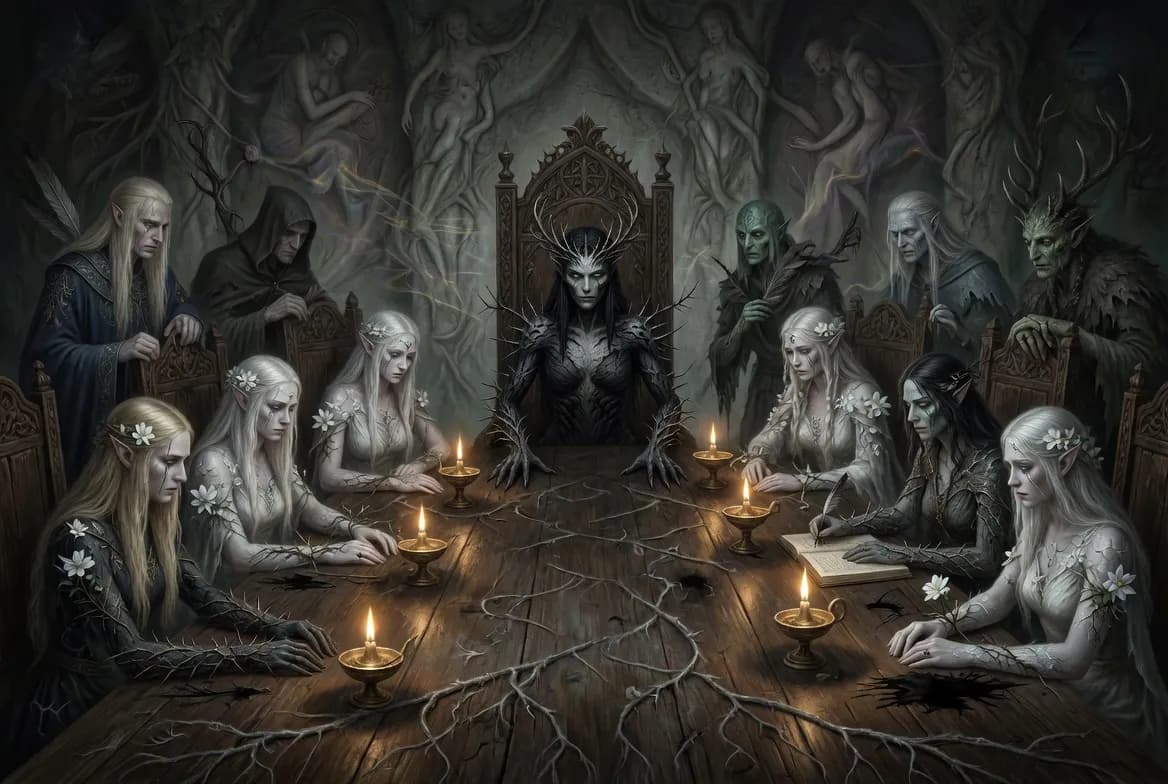
And so they stood. Ten fragments of a maker's nature, arranged in two courts that disagreed about everything except the fact that the world required their attention.
The Archons looked at the world and saw something that needed to be maintained: preserved, ordered, protected from the entropy creeping at its edges. They were the conservative principle, not in the political sense, but in the physical one. They resisted change not because change was evil but because unstructured change is indistinguishable from decay.
The Archfiends looked at the same world and saw something that needed to be used: explored, transformed, consumed and remade. They were the progressive principle, not in the moral sense, but in the thermodynamic one. They demanded change not because change was good but because stasis is indistinguishable from death.
Both were right, in the way that two hands disagree about which direction to reach. The left hand and the right hand serve the same body. You need both to clap, to hold, to build.
But hands do not know they serve the same body. And when direction becomes conviction, and conviction becomes identity, and identity becomes the unshakable certainty that your way of reaching is the only way that leads somewhere worth going...
Then the hands become fists.
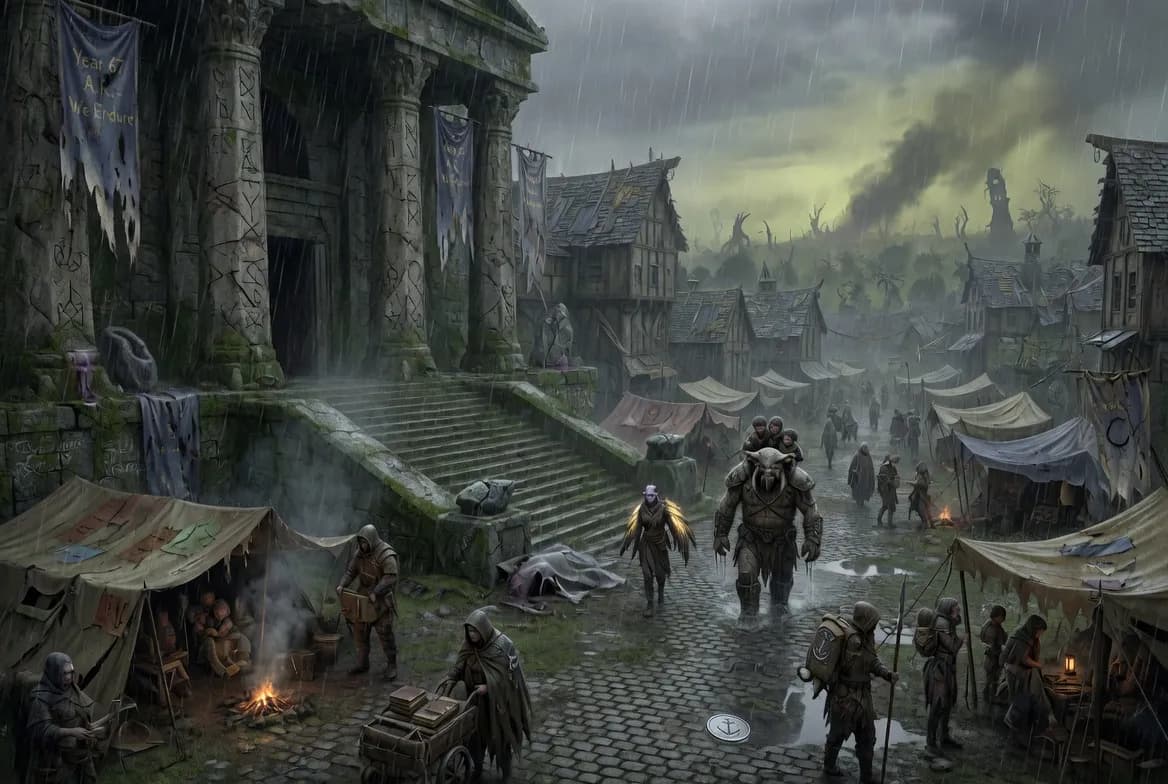
For a time, measured in mortal generations, long enough for the mortals to forget there had been a time before gods, but not long enough for the gods to forget they had been born, the two Courts coexisted. The Empyrean Court raised its domain on the sunlit peaks of Mount Solaris. The Infernal Concord carved its home from the volcanic caldera the mortals would learn to call Vorath Kel.
The reason to fight was coming. It was already walking the roads of Talor, praying to both Courts with the cheerful pragmatism of a people who had never seen the point of choosing sides.
The Hearthborn. Always the Hearthborn.
But that is a story for another chapter, and another kind of sorrow.
For now, the gods stood in their high places and looked at the world they had inherited from an echo, and each believed, with the absolute conviction of a being that had never been wrong because it had never existed long enough to be tested, that they knew what the world needed.
None of them asked the world.
None of them thought to.
Select text to add a note.