The Breaking
In which a king reaches for the voice of God, and the world cracks open.
"The Grundir who built the chamber told me, years later, that the angles were wrong. Not wrong in a way you could measure. The geometry was perfect, he said, flawless to tolerances that even Grundir masons rarely achieved. Wrong in a way you could feel. He said the stone didn't want to be shaped that way. He said it felt like building a cage for something that shouldn't be caged. I asked him why he didn't stop. He said he tried. He said no one listens to the stone."
—Hearthborn Chronicler Darren Ashbridge, Interviews with the Survivors, 43 A.R.
I. Seven Years
It took seven years to build the thing that would end the world.
The Breaking was not an accident. It was not a moment of passion, a spell gone wrong, a single catastrophic miscalculation made in haste and repented at leisure. It was a project. It had timelines. It had budgets. It had a committee.
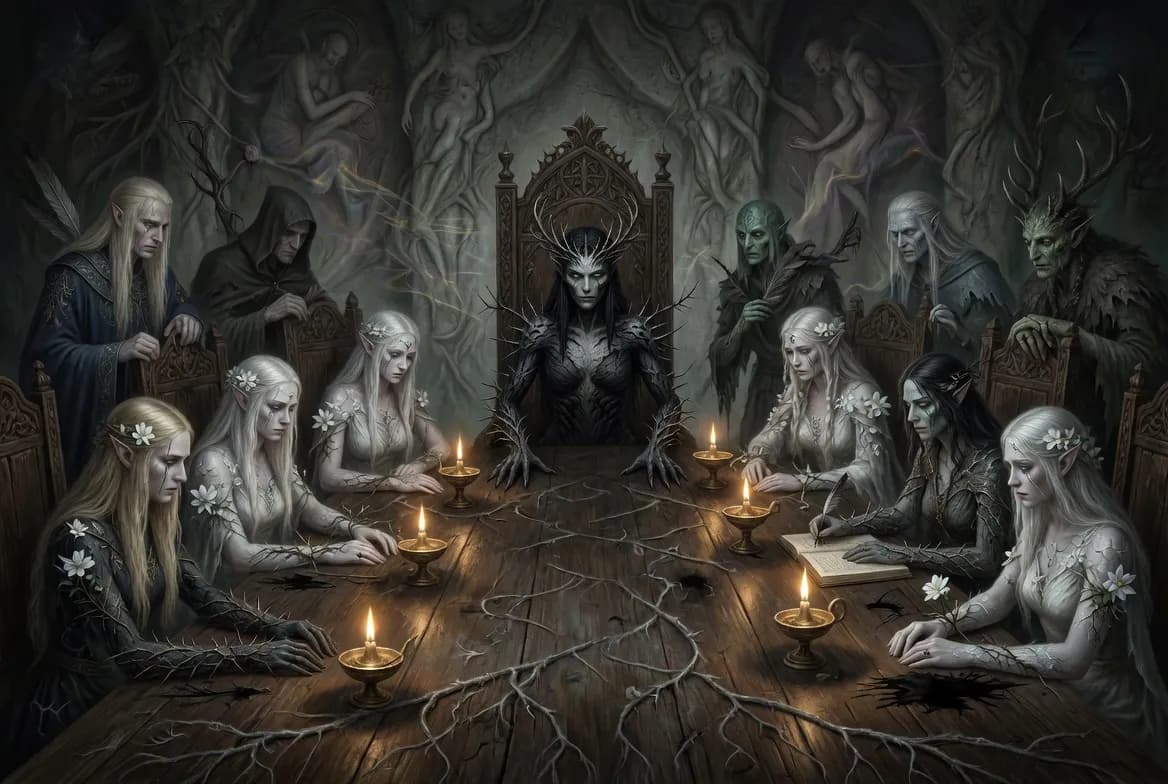
House Veylith's greatest scholars designed the ritual. They worked in the Spiral Archive beneath Feladan, in chambers so deep that the roots of the great city-tree formed the ceiling, their pale tendrils groping downward through the stone like the fingers of a hand reaching for something it had dropped. The scholars filled these chambers with diagrams. They covered every wall, every surface, every available inch of ancient root-bark with calculations so dense that a Vyssari mathematician who examined the surviving fragments centuries later described them as "technically exquisite and morally deranged."
The theory was sound. That was the worst part. Every step of the logic was defensible. Every conclusion followed from its premises with the clean, cold inevitability of water running downhill. If the echo of Aethon's voice still resonated in the substrate of reality, and it did, demonstrably, measurably, the Green Communion proved it every day, then that resonance could be amplified. If it could be amplified, it could be sustained. If it could be sustained at sufficient intensity, it would halt the entropic decay that was allowing the small pauses in reality, the caesurae, the scholars' curiosity, the philosopher's footnote, to form and spread.
The world was fraying. Slowly, imperceptibly, like a tapestry left too long in the sun. The caesurae were proof. And Aeloran, brilliant Aeloran, golden Aeloran, the most powerful mortal mage who had ever lived, looked at the fraying and saw a problem to be solved.
He would strengthen the echo. He would amplify the residual voice of creation until it became self-sustaining, a permanent harmonic that would ring through the bones of the world forever, holding reality together the way the original voice had held it together when it was new. He would fix the world.
He needed only three things: a chamber, a conduit, and a language.
The chamber was the easy part.
II. The Chamber Beneath Feladan
The Grundir were hired because no one else could do what needed to be done. The chamber required tolerances that Vaelith masons could not achieve, because the work demanded something beyond skill. It demanded the Grundir's understanding of stone, that bone-deep intuition for material that was less a craft and more a conversation. The walls had to be lined with Resonance-conducting crystal, harvested from the deep places where Aethon's voice still hummed in the bedrock. The geometry had to be perfect. Not aesthetically perfect, not architecturally perfect, but harmonically perfect, every angle calibrated to amplify and sustain a standing wave of creative energy.
A Grundir engineer named Vekk Stonewarden led the construction crew. He was the finest geometric mason of his generation, a man who could feel stress fractures forming in stone before they appeared, who could lay a course of blocks so precisely fitted that water would not pass between them. He had built sections of Grayhold's deepest halls. He had repaired Anchor Stones. He understood resonance the way a musician understands pitch: as a felt reality, a vibration in the bones of his hands.
And from the first day, he knew something was wrong.
The geometry was perfect. That was the problem. The angles were calculated to channel energy inward, to focus it, to compress it. Every surface was a mirror, every corner a lens. The chamber was designed to take the natural, diffuse resonance of the world and concentrate it into a single point: the center, where Aeloran would stand.
Vekk had spent his life working with resonance. He knew what concentrated resonance felt like. He had felt it in the deep places where the earth's core came close to the surface and the stone hummed so loudly that it could loosen teeth. Concentrated resonance was not gentle. It was not a strengthening. It was a pressure. And pressure, applied to the wrong thing in the wrong way, does not reinforce. It ruptures.
He submitted his report to House Veylith's oversight committee in the third year of construction. It was eleven pages long, meticulous, measured, written in the precise technical language of Grundir engineering. It said, in summary: the chamber will work exactly as designed. The energy will focus exactly as intended. But the focal point will experience pressures that exceed any known tolerance for any known material, including the barrier between planes of existence. He recommended redesigning the geometry to distribute the energy rather than concentrate it. He recommended reducing the number of conduits. He recommended, failing all else, that the project be abandoned.
The committee thanked him for his thoroughness. They filed the report. They did not change the design.
Vekk asked for a meeting with Aeloran directly. He was denied. He asked again. He was denied again, more firmly, with a note suggesting that Grundir engineers were being compensated for their labor, not their opinions. He asked a third time and was told that the contract included a penalty clause for delays, and that further objections would be construed as a delay.
Vekk finished the chamber. He did this because he was Grundir, and the Grundir finish what they build, and because he was a professional, and professionals do not walk away from contracts, and because some part of him wanted to see if he was wrong. That last part haunted him for the rest of his life, the part he confessed to the Hearthborn chronicler decades later with a voice like gravel being ground to dust.
He was not wrong.
III. The Conduits
The Dryathi did not volunteer.
The Vaelith histories of the period, the ones that survived the Breaking, the ones that House Aelindra curated and preserved, use language that obscures this fact. They say the Dryathi "participated." They say the Dryathi "served their role in the great work." They use the passive voice the way a mason uses mortar: to fill the gaps between uncomfortable truths.
The Dryathi were slaves. They had been slaves for two hundred years. The binding of the Rootsong had not been loosened or reformed or made more humane in the intervening centuries; it had been refined. Perfected. What had begun as a crude hijacking of the Dryathi's empathic network had become, under House Veylith's patient scholarship, something much worse: an invisible cage so well-fitted that the prisoners had forgotten what freedom felt like. The Rootsong still flowed. The Dryathi still felt the forests and rivers and the slow pulse of the living world. But the song had a new verse now, woven so deeply into its fabric that most Dryathi could no longer distinguish it from their own thoughts: obey.
Seven hundred were selected. The criteria were precise and terrible: the strongest connections to the Rootsong, the deepest roots in the empathic network, the greatest capacity to channel Resonance without immediate physical collapse. They were, in effect, selected for their ability to survive being used as conduits for forces that would have killed lesser beings instantly. The Vaelith scholars framed this as a compliment. The strongest. The most gifted. The chosen.
They were brought to the chamber beneath Feladan in the weeks before the ritual. Some walked on their own feet, guided by the binding in their minds. Others were carried, not because they resisted, but because the binding had been tightened so severely in preparation for the channeling that their bodies had gone rigid, locked into a state of enforced calm that looked, from the outside, like serenity. Like willingness. Like consent.
It was none of these things.
They were arranged in concentric circles around the focal point. Seven rings, one hundred Dryathi in each ring, standing shoulder to shoulder in the crystalline chamber, their bare feet on the Resonance-conducting stone, their arms raised, their eyes open. The configuration was geometric, each Dryathi positioned at a precise point in the harmonic pattern, each body a node in a network designed to channel the Resonance of the entire continent through seven hundred living hearts and into the center of the circle, where Aeloran stood.
The Rootsong connected them. It had always connected them, every Dryathi to every other Dryathi, an empathic web that spanned the world, carrying the heartbeat of every forest, the breath of every river, the slow tectonic pulse of the land itself. Now that web was being used as a funnel. Every whisper of Resonance that flowed through every blade of grass on Aradoth would be gathered, focused, compressed, and delivered to a single point.
The energy required was staggering. The scholars of House Veylith had calculated it to fourteen decimal places. They had accounted for resistance, for dissipation, for the natural damping effects of distance and material. They had not accounted for the possibility that the energy itself might not want to be used this way, because energy wanting things was not part of their theoretical framework.
The Grundir could have told them about this. The Grundir knew that stone had preferences. That metal remembered the shape it wanted to be. That the deep earth had moods. But no one asked the Grundir. The Grundir had been paid, and their opinions had been filed, and the chamber was built, and the geometry was perfect.
IV. The Words That Were Almost Right
On the day of the ritual, Aeloran entered the chamber alone.
He was magnificent. The histories agree on this, even the Dryathi histories, which have no reason to be generous. He was tall, even for a Vaelith, nearly seven feet, lean and angular, with the sharp-edged beauty that the Vaelith cultivated through centuries of selective partnership. His hair was the color of white gold. His eyes held the deep green luminescence that marked exceptional sensitivity to the echo, the same glow that the first Vaelith had seen in the eyes of the ancients who taught them the Green Communion. He wore no armor, no crown, no regalia. He wore simple white robes, and he carried nothing in his hands.
He carried everything in his voice.
Aeloran had spent forty years studying the echo of Aethon's creation. He had mapped its frequencies. He had catalogued its harmonics. He had identified patterns in the residual vibration that corresponded, imperfectly, tantalizingly, maddeningly almost, to syllables. To phonemes. To the ghost-shapes of words in a language that had existed before language existed. He had reconstructed, through decades of painstaking scholarship, fragments of the creation tongue.
Not the creation tongue itself. That distinction is critical, and it is the distinction that killed seven hundred people and broke the world.
What Aeloran had reconstructed were approximations. Echoes of echoes. The shapes that mortal vocal cords and mortal lips and a mortal tongue could produce that came closest to replicating sounds that had never been meant for mortal mouths. It was like a child drawing a picture of the sun: recognizable, even beautiful, but fundamentally different from the thing it represented. The drawing is flat, static, cold. The sun is a nuclear furnace that gives life to worlds. The difference between them is not one of degree. It is one of kind.
Aeloran believed the difference was one of degree.
He stepped into the center of the circle. Seven hundred Dryathi surrounded him, their eyes open and empty, their bodies rigid with enforced compliance, the Rootsong humming through them like current through wire. He could feel the Resonance gathering, the energy of every living thing on the continent flowing through the empathic network, through the seven hundred conduits, through the geometric perfection of the crystalline chamber, converging on him like light through a lens.
He opened his mouth. He spoke.
The words came slowly at first. Low, measured, precise, each syllable placed with the care of a jeweler setting stones. They were not words in any living language. They were older than language. They were the shapes that language had been before it forgot what it was made of. Aeloran spoke them, and the Resonance in the chamber shifted, responding, the way a tuning fork responds to a note struck on a nearby instrument.
The first ring of Dryathi stiffened. Their connection to the Rootsong deepened involuntarily, pulled open like a wound, and through them the Resonance of the nearest forests poured into the chamber. The crystal walls sang. The stone beneath their feet vibrated at a frequency that Vekk Stonewarden, standing in a monitoring alcove a hundred yards above with his hand pressed to the wall, recognized immediately.
It was the frequency he had warned them about. The focal frequency. The one his calculations said the barrier between planes could not withstand.
He began to run.
Below, Aeloran continued. The words grew more complex, layering on each other, harmonics building on harmonics. The second ring of Dryathi was drawn in, then the third. Each ring added its resonance to the matrix, and the sound in the chamber changed, deepened, widened, became something that was felt in the marrow rather than heard in the ear. The air itself began to thicken. Light bent at the edges of the room, the crystalline walls refracting things that should not have been visible: flickers of color that had no name, shadows that moved against the direction of their sources, a faint shimmer in the air above Aeloran's head that looked, if you squinted, like a tear in a piece of cloth. A place where the fabric of reality was being stretched too thin.
By the fourth ring, the Dryathi were screaming. Not aloud; the binding held their voices. But through the Rootsong, through the empathic web that connected them to every living thing on the continent, the scream was deafening. In the forests above Feladan, birds fell from the sky. In rivers fifty miles distant, fish went belly-up, their small lives snuffed by the psychic pressure bleeding through the network. In Dryathi communities across Aradoth, the tiny, tightly-controlled enclaves where unbound Dryathi still lived in hiding, pretending to be something less than they were, individuals dropped to their knees, clutching their heads, feeling the agony of their enslaved kin as if it were their own.
Because it was their own. The Rootsong did not distinguish. Pain shared through the empathic web was not like pain; it was pain. Seven hundred Dryathi in agony meant every Dryathi on the continent was in agony. The binding had been designed to prevent the channelers from resisting. It had not been designed to prevent them from suffering. House Veylith's scholars had not considered this relevant.
Aeloran heard the screaming. He heard it through the Resonance itself, a discordant note in the harmony he was building, a vibration that did not belong. He could have stopped. In the seconds between the fourth ring's activation and the fifth, there was a window, a brief, vanishing moment in which the accumulated energy could still have been dispersed, bled off through the crystal walls, returned to the diffuse hum from which it had been gathered. He would have had to abandon the ritual. He would have had to accept failure. He would have had to look at seven hundred suffering Dryathi and acknowledge that their pain was not a necessary cost but a crime.
He chose not to stop.
The fifth ring. The sixth. The sound in the chamber had passed beyond anything mortal ears could process. It was not loud. It was not a vibration in the air. It was a vibration in reality, the creative substrate itself resonating in sympathy with Aeloran's approximation of the creation tongue, the bones of the world humming along to a song that was almost, almost, almost the song they remembered.
Almost.
The seventh ring activated. All seven hundred Dryathi were now channeling simultaneously, and through them the combined Resonance of every forest, every river, every field, every living root and running stream on the entire continent of Aradoth poured into the chamber beneath Feladan and focused on a single point: the space three inches in front of Aeloran's lips, where the words he was speaking met the energy that was being fed to them.
The air tore.
V. The Voice
For one moment, a moment so brief that it existed between heartbeats, in the space between one instant and the next where time itself becomes uncertain, Aeloran heard the voice of God.
Not the echo. Not the residual vibration. Not the fading murmur that Aethon Seekers spent their lives straining to hear, the ghost-sound in the deep stone, the almost-hum in the oldest trees. He heard the voice itself. Aethon's voice. Unmediated. Undiminished. As vast as creation and as intimate as a whisper spoken directly into the ear, the way a parent whispers to a sleeping child, so close that the words are felt as breath before they are understood as language.
And the voice was sad.
Not angry. Every telling of the Breaking that casts it as divine punishment, as the wrath of a god provoked by mortal hubris, misses the point so completely that the missing is itself a kind of blasphemy. Aethon was not angry. He had given his creation the gift of silence precisely so that they could make their own choices, including catastrophically wrong ones. He had loved them enough to leave. He had left them enough to fail.
The sadness was not for himself. It was the sadness of a parent who watches a child touch the fire after being told, gently and repeatedly, that fire burns. Not the anger of "I told you so." The grief of "I knew you would, and I couldn't stop you, because stopping you would have been worse than the burn."
Aeloran heard this sadness, and in the hearing, he understood.
He understood that the creation language was not a tool. It was not a technology. It was not a system that could be reverse-engineered and replicated and deployed for useful purposes, no matter how noble those purposes might be. The creation language was the living voice of a being who had loved the world into existence, and speaking it with mortal lips, mortal lips that had ordered the enslavement of an entire race, through conduits made of suffering, fueled by stolen Resonance ripped from the living world without its consent, was not amplification.
It was desecration.
And the world, which had been spoken into being by love, recoiled from the desecration the way living flesh recoils from a brand.
VI. The Shattering
The barrier between planes did not break gradually. It did not crack and spread and give warning. It shattered. The way glass shatters: all at once, everywhere, the integrity of the whole thing failing in a single catastrophic instant because glass does not break in part. Glass is either whole or it is a thousand pieces, and there is no intermediate state.
The barrier between the living world and the Realm of Blight had been stretched thin by the caesurae, those small pauses, those philosopher's curiosities, those footnotes in academic papers that no one had taken seriously enough. Each caesura was a point of weakness. Each point of weakness was a stress concentrator. And when the barrier failed at the focal point beneath Feladan, the failure propagated outward along those weaknesses at the speed of thought, and the barrier between life and unlife shattered across half a continent in the time it takes to draw a breath.
The Blight erupted from beneath Feladan like an inverted volcano. Not fire. Not lava. Something worse. An absence that had weight. A nothing that consumed. It poured upward through the ritual chamber, through the stone, through the roots of the great city-tree, and it was grey. Not the grey of storm clouds or old stone, but the grey of a world with the color removed, the grey of meaning being subtracted from matter, the grey of a word being unspoken.
The seven hundred Dryathi died.
They died in an instant, all of them, simultaneously, their bodies simply stopping, the way a candle stops when you pinch the flame. One moment they were alive, in agony, channeling forces that were tearing them apart from the inside. The next moment they were gone. Not dead in the way that living things usually die, with a winding down, a slowing, a final breath. Dead the way a sound is dead when the thing making it is destroyed. Abruptly. Completely. Without remainder.
The Rootsong snapped.
This was not a metaphor. The Rootsong was a real thing, an empathic network connecting every Dryathi on the continent to every other Dryathi and to the living world itself. When seven hundred nodes in that network were destroyed simultaneously, the network did not simply lose seven hundred connections. It convulsed. The psychic backlash ripped through every Dryathi on Aradoth with the force of seven hundred deaths experienced as one.
In the forests north of Feladan, a Dryathi community of thirty, unbound, hiding, living quietly in the canopy of a grove so old the trees had names, collapsed as one. They fell from branches, from platforms, from the high places where they lived close to the light. Some survived the fall. All of them survived the psychic impact, though "survived" is a generous word for what was left of them after feeling seven hundred of their kin die inside their own minds. They lived. But something in them broke that day, something in the Rootsong itself, in the shared consciousness that made them a people rather than a collection of individuals, and it has never fully healed.
In the slave quarters of a dozen Vaelith cities, bound Dryathi screamed in voices they were not supposed to be able to use. The binding magic, carefully maintained for two centuries, faltered and failed in a chain reaction that took less than a minute. The Rootsong, overloaded with agony, burned through the Vaelith control like fire through paper. Dryathi who had been compliant for generations suddenly, violently, were not. Some attacked their masters. Some simply ran. Most fell to the ground and did not move for days, trapped in a waking nightmare of seven hundred deaths replaying endlessly through a network that could not stop transmitting what it had received.
The binding was broken. After two hundred years, the Dryathi were free.
They did not celebrate. They would never celebrate this freedom. It had been bought with seven hundred lives, paid for in a currency of suffering so extreme that the receipt was written on the soul of every Dryathi who lived and every Dryathi who would ever be born. The Rootsong carries the memory. It always will. There is a frequency in the empathic web, a low, almost inaudible vibration at the very bottom of the Dryathi's shared consciousness, that is the echo of that scream. Dryathi children feel it before they have words. Dryathi elders hear it in their sleep. It is the scar that the species carries, and it does not fade.
VII. What Happened to Aeloran
There are three versions. There have always been three versions, and the argument between them has never been settled and never will be, because the only witnesses were the dead and the Blight, and neither speaks in a language the living can parse.
The first version is House Aelindra's, and it is the kindest.
In this telling, Aeloran, shattered by understanding, devastated by the consequence of his ambition, but still possessed of the staggering magical power that had made him the most formidable mortal mage in history, turned that power against the Blight. He fought. Standing at the epicenter of the worst catastrophe the world had ever known, surrounded by the bodies of seven hundred people he had killed, watching reality unravel around him, he fought with everything he had. He poured his personal Resonance into the breach, trying to close it, trying to hold the barrier together through sheer force of will. He bought time, minutes, perhaps hours, during which the Vaelith above evacuated the lower levels of Feladan. He held the Blight at bay long enough for runners to reach the outlying settlements with warnings. And then the Blight consumed him, and he died a hero's death, redeemed by sacrifice, his great sin partially expiated by his final act.
This version is comforting. This is why House Aelindra tells it.
The second version is the Dryathi's, and it is the cruelest.
In this telling, Aeloran did nothing. He stood at the center of the chamber, surrounded by the dead, watching the Blight pour through the wound he had made, and he did not fight, did not flee, did not lift a hand or speak a word. Not because he was a coward. Because he understood. In the moment of the Breaking, when he heard Aethon's voice and felt the full weight of what he had done, the understanding destroyed him more completely than the Blight ever could. His mind simply stopped, the way the Dryathi's bodies had stopped. Not winding down, not fading, but ceasing, all at once, the way a sound ceases when the instrument is broken. He stood there, alive and empty, until the Blight reached him, and by then there was nothing left to consume. He was already gone. The body was a formality.
This version offers no redemption. This is why the Dryathi tell it.
The third version is whispered only in the sealed archives of House Veylith, and it is the one that wakes people in the night.
In this telling, Aeloran did not die. The Blight reached him and took him, but it did not destroy him. It kept him. The most powerful mortal mage who had ever lived, the only mortal who had ever spoken even an approximation of the creation language, the mind that had spent forty years mapping the architecture of reality itself: the Blight consumed his body but preserved his consciousness. Twisted it. Corrupted it. Turned it to purposes that are the inverse of everything Aeloran had intended.
Somewhere in the deepest heart of the Caesura, in the place where reality has been so thoroughly unmade that the concepts of "place" and "where" no longer apply, Aeloran exists. Not alive. Not dead. Something else. Something that remembers what it was, that remembers the creation language, that remembers how to speak words that reshape reality. Something that uses that knowledge now in the service of entropy, of unmaking, of the silence that the Blight embodies.
This version terrifies everyone who hears it, because it implies that the Caesura is not merely a wound. It implies that the Blight has intelligence, not its own, but one it stole from the greatest mind of an age. It implies that the thing consuming the world is not a natural disaster but a corrupted genius, wielding the tools of creation in reverse.
House Veylith sealed the archives that contain this hypothesis. They sealed them with locks that have no keys. They sealed them behind walls that have no doors. And they placed, above the sealed section, a plaque that reads, in the old Vaelith script: Do not look for what you are not prepared to find.
Nobody has opened them.
Nobody has proven the hypothesis wrong, either.
VIII. How the World Felt the Breaking
The Breaking was not a local event. It was something that happened to the world. And the world felt it the way a body feels a wound: all at once, everywhere, the shock radiating outward from the point of injury to every extremity, every organ, every cell.
The Grundir felt it in their hands.
In the deep halls of Grayhold, three hundred miles from Feladan, every Grundir craftsman alive reported the same experience at the same moment: their tools felt wrong. Not broken. Not damaged. Wrong. The hammer that had been an extension of the arm for thirty years suddenly felt like a foreign object, a thing made of stuff that the hand did not recognize. The tongs that had gripped hot metal with perfect surety suddenly gripped with hesitation, as if the metal had forgotten its own properties and the tongs had forgotten how to hold it.
It lasted only a moment, a single heartbeat of wrongness, and then the tools were tools again and the metal was metal and the world made sense. But that moment was enough. Every Grundir who felt it understood, in the immediate, bone-deep way that the Grundir understand things, that something fundamental had changed. Something in the deep architecture of reality, in the relationship between material and form, between the thing and its nature, between what a thing is and what a thing does, had been damaged.
The Master Forger of Grayhold was a man named Thorn Deepvein. He was sixty years old, which is young for a Grundir in a position of authority. He had hands like shovels and eyes like drill bits and a mind that worked the way good stone works: under pressure, it became harder. He felt the wrongness in his forge hammer, set it down carefully on the anvil, walked to the main communication shaft, and issued three orders in rapid succession.
Seal the upper entrances. Inventory the armory. Send runners to every Grundir settlement with a single message: Something broke. Prepare.
He was the first non-Vaelith to understand what had happened, though he did not yet have the details. He did not need the details. The Grundir do not require explanations for things they can feel. The stone was grieving. That was enough.
The Kithara felt it in their bones.
The moons did not dim, not literally, not in any way that a Hearthborn astronomer with a telescope could have measured. But the Kithara do not experience moonlight the way other races do. For the Kithara, moonlight is physical. It has temperature. It has weight. It presses against the skin like a warm hand on a cold night, and the Kithara navigate by it, hunt by it, make love by it, die by it. Moonlight is not illumination. It is presence.
And for three nights after the Breaking, the moonlight went cold.
Every Pride on the continent reported the same phenomenon. The moons hung in the sky as they always had, silver and white and faintly golden, but their light arrived without warmth, without weight, without the tactile quality that made it moonlight rather than mere reflected sun. It was like hearing a familiar voice speak in a language you don't understand. The sound is the same, but the meaning has been removed, and the absence of meaning is more disturbing than silence.
Pride leaders across the continent reported the same dream during those three cold nights. They dreamed of a voice speaking a single word, a word they could not understand, in a language they had never heard, followed by silence. Not ordinary silence. Silence with texture. Silence that pressed against the eardrums the way deep water presses against the chest. Silence that had volume and mass and occupied space. Silence that was, itself, a kind of sound: the sound of something enormous and vital being subtracted from the world.
The Kithara had no word for what had happened. They had lived for millennia without needing one. In the days after the cold nights, the eldest of the Pride leaders, a scarred hunter named Thessk Moon-Eye, who had been old when most of the other Pride leaders were born, gathered the Prides for a council, which the Kithara almost never do, because the Kithara distrust any gathering that cannot be disbanded by running. He stood before them and said: "The moons grieved. I do not know why. But the moons have never grieved before."
They invented a word for it: koss-kessara. The night the moons grieved. It passed into the Kithara language as both a date and a concept, the moment when something that had always been reliable became, for the first time, uncertain. Kithara parents still use it to mark the boundary between the old world and the new. Before koss-kessara, they say. After koss-kessara. As if the world were a bone that had been broken and reset, the same shape but never quite the same strength.
The Vyssari felt it in the Current.
The Ancestral Current, that great, slow river of shared memory that the Vyssari had been maintaining since Aethon opened it as a gift, experienced something that had never happened before in its existence. Not a new memory. Not a disturbance. Not even the tremor that Vyssari Conclave members had felt during the Sundering of the divine Courts, when the gods went to war and the mortal world shook. This was different. This was worse.
It was an absence.
A place in the collective memory where something had been and was now... not. Not forgotten; the Current does not forget. Not suppressed; the Vyssari had long since ceased the practice of filing inconvenient memories below the threshold of easy access. Simply absent. A gap. A hole in the fabric of shared consciousness shaped like a thing that no longer existed, and the Current flowed around it the way water flows around a stone, smoothly, without turbulence, but with a persistent deviation in its course that indicated something was there. Something that could not be remembered because there was nothing left to remember. Something that had been subtracted so completely that even the memory of it had been consumed.
The Conclave entered emergency session. Twenty-three Elders, the oldest and most deeply connected minds in Vyssari civilization, submerged themselves in the Current and searched for the source of the absence. They searched for seventeen days. Seventeen days of continuous immersion, of following the gap through the layered strata of collective memory, tracing its edges, measuring its depth. When they emerged, their scales had gone pale with exhaustion and their eyes held the hollow look of people who have seen something they cannot describe and will spend the rest of their lives trying not to think about.
They issued a single statement. It was recorded by every Vyssari chronicler on the continent, carved into the basalt walls of the Conclave chamber, and entered into the Current itself as a memory of absolute priority, the highest classification the Vyssari had, reserved for knowledge so important that it must never be allowed to sink below the surface of consciousness.
"The world has been wounded. The wound will not heal on its own."
That was all. Seventeen days of investigation distilled into two sentences. The Vyssari do not waste words. But the second sentence, the wound will not heal on its own, contained an implication that every Vyssari who read it understood: if the wound would not heal on its own, then someone would have to heal it. And healing a wound in the world itself was not a task that any single race could accomplish.
The age of isolation was over. The Vyssari had known this before anyone else, and they had known it in the way they knew everything: as a memory. The Current remembered a world that was whole. It could feel the shape of the wound. And the shape told them that the wound was too large for any one set of hands.
The Arak'thur felt it as a storm.
On distant Trandalar, across the frozen northern seas, the Arak'thur had been living in the same Holds for millennia, carving their civilization into the ice and stone of a continent that punished weakness and rewarded endurance. They did not know the Vaelith. They did not know the Dryathi. They barely knew the sea-traders who occasionally braved the northern passage to trade iron for whale oil. Their world was small and cold and complete.
The storm hit without warning. The sky went black, not the black of night or cloud, but the black of negation, the sky itself refusing to be sky for a moment before crashing back into existence as wind and lightning and ice. The storm lasted nine days. These were not the storms the Arak'thur were accustomed to, the slow, grinding blizzards that came every winter, predictable as sunrise, endurable as stone. This was different. This storm had rage in it, and beneath the rage, something the Arak'thur shamans had never felt in the weather before.
Fear.
The Storm Fathers, the primal forces that the Arak'thur worshipped, not as gods exactly, but as the living voices of wind and ice and lightning, were afraid. The shamans felt it in the quality of the thunder, in the way the lightning struck not downward but sideways, as if flinching from something. In the way the wind howled not with hunger but with alarm, the way a wolf howls when it is hunted rather than when it hunts.
The shamans gathered in the deepest Hold, where the ice was oldest and the stone remembered the world's first winter, and they listened. They listened to the storm the way musicians listen to a new composition, for the structure beneath the noise, for the melody beneath the chaos. And what they heard, when they finally parsed the Storm Fathers' language of wind and ice and electric fury, was a single concept, expressed not in words but in the raw grammar of weather:
Something that should not have been opened has been opened, and it cannot be closed.
The Tesseri felt it in their ledgers.
Markets crashed. This is a simple sentence, and it describes an event that was anything but simple. The Tesseri had spent centuries building the most sophisticated economic network the world had ever seen, a web of trade routes, contracts, futures markets, insurance instruments, and credit mechanisms that connected every major civilization on Aradoth. The Grand Exchange in Rachival was the beating heart of this network, a vast trading floor where Tesseri brokers bought and sold everything from Grundir steel to Vaelith timber to Kithara hunting contracts.
On the day of the Breaking, every commodity on the Exchange lost value simultaneously. Not because of news; news would not reach Rachival for days. Not because of rational assessment of risk; the Tesseri did not yet know there was a risk to assess. The markets crashed because the Tesseri, who had the finest instinct for value of any race on Aradoth, collectively felt that something had changed in the fundamental equation of supply and demand. Something had been subtracted from the world. They did not know what. But they knew it was large, and they knew it was irreplaceable, and they knew that the loss of an irreplaceable thing reprices everything.
The Grand Exchange closed its doors for the first time in its three-hundred-year history. The silence in the trading hall was deafening, a room built for shouting, designed for the roar of commerce, suddenly and completely still. Tesseri traders stood at their posts and stared at numbers that no longer made sense, at contracts that no longer had meaning, at a future that had just become radically uncertain.
Tessren, a banker, the great-great-grandson of Greshen the Unlikely, who had brokered peace between gods, stood on the floor of the Exchange and spoke the epitaph for the old world's economy. His voice was calm. The Tesseri are always calm about money, even when the money is on fire.
"I don't know what happened," he said. "But I know what it costs. And I don't think anyone can afford it."
The Hearthborn felt it as an earthquake.
In Talor, the Hearthborn city, the mongrel city, the city that had been built and rebuilt and built again by a race that could not stop building, the ground shook. The walls of the market district cracked. The great square, the heart of the city, split down the middle, a fissure opening in the cobblestones that would never fully close, that would become in later years a landmark and a memorial, the place where the old world ended and the new one began.
People screamed. People ran. People did what Hearthborn always do in a crisis: they grabbed the nearest tool and tried to fix something. Masons reached for trowels. Carpenters reached for hammers. A baker on Market Street, her ovens cracking, her flour dusting the air like pale snow, reached for a broom, because the broom was what her hands found first and Hearthborn hands need to be holding something or they shake.
And in the chaos, standing on the broken stones of the market square, a Hearthborn prophet spoke.
Her name was Eldest Mar. She was very old, old enough that no one remembered her being young, old enough that her age had become a landmark in itself, a fixed point around which the neighborhood organized its understanding of time. She was small and bent and her eyes were the color of river stones, and she had never, in anyone's memory, spoken a prophecy before. She was not a seer. She was not a mystic. She was a woman who sold herbs in the market and told children stories and knew the name of every cat on her street.
But she stood on the broken stones, and the earthquake stilled around her, not because she commanded it, but because the earth itself seemed to pause, the way a crowd pauses when someone begins to speak, and she opened her mouth, and what came out was not her voice. It was older than her voice. It came from a deeper place.
"The song is breaking," she said. "The pause between verses has become a silence. And in the silence, something is listening."
She never spoke another prophecy. She never explained the one she had given. When asked, later, what she had meant, she said only: "I didn't say it. Something said it through me. And I think it was trying to warn us."
She died three months later, peacefully, in her bed, surrounded by cats. The Hearthborn carved her words into the wall of the rebuilt market square, and they are there to this day, weathered but legible, a reminder from a woman who sold herbs that the world had changed and would not change back.
IX. What Was Lost
In the immediate aftermath, the tallying began, because that is what the living do when the dying stops: they count what remains and try not to think about the difference between what they have and what they had.
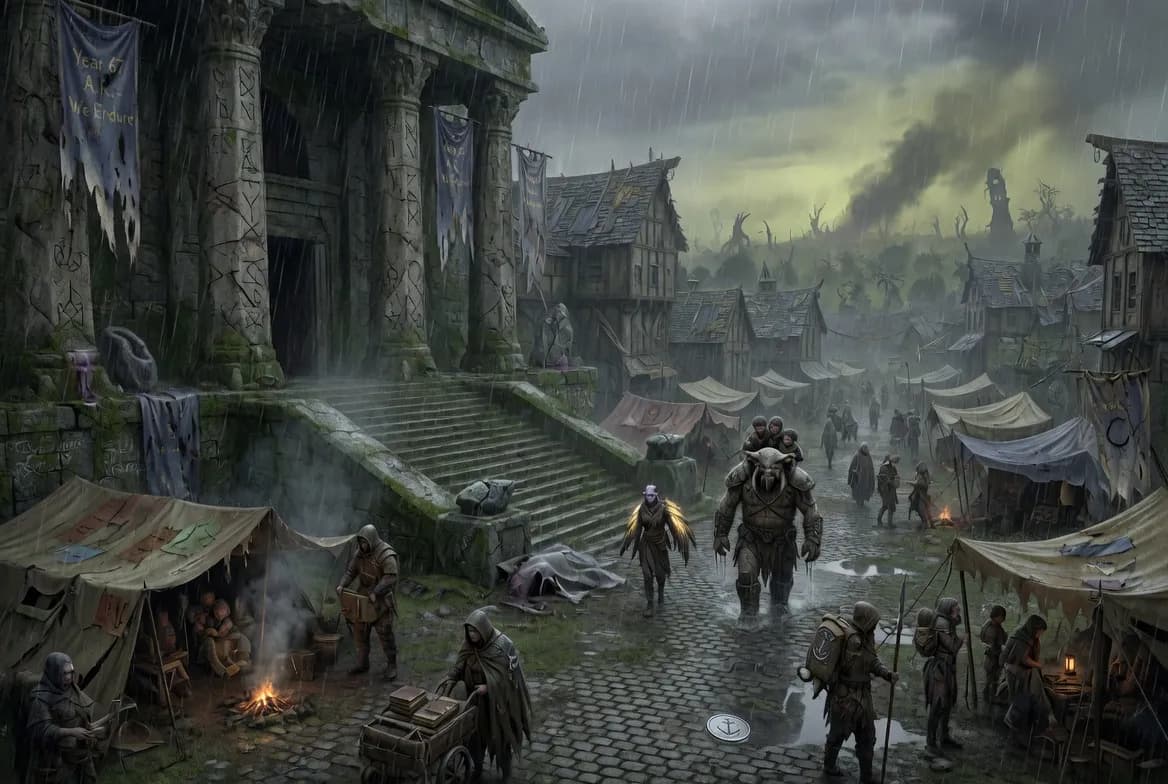
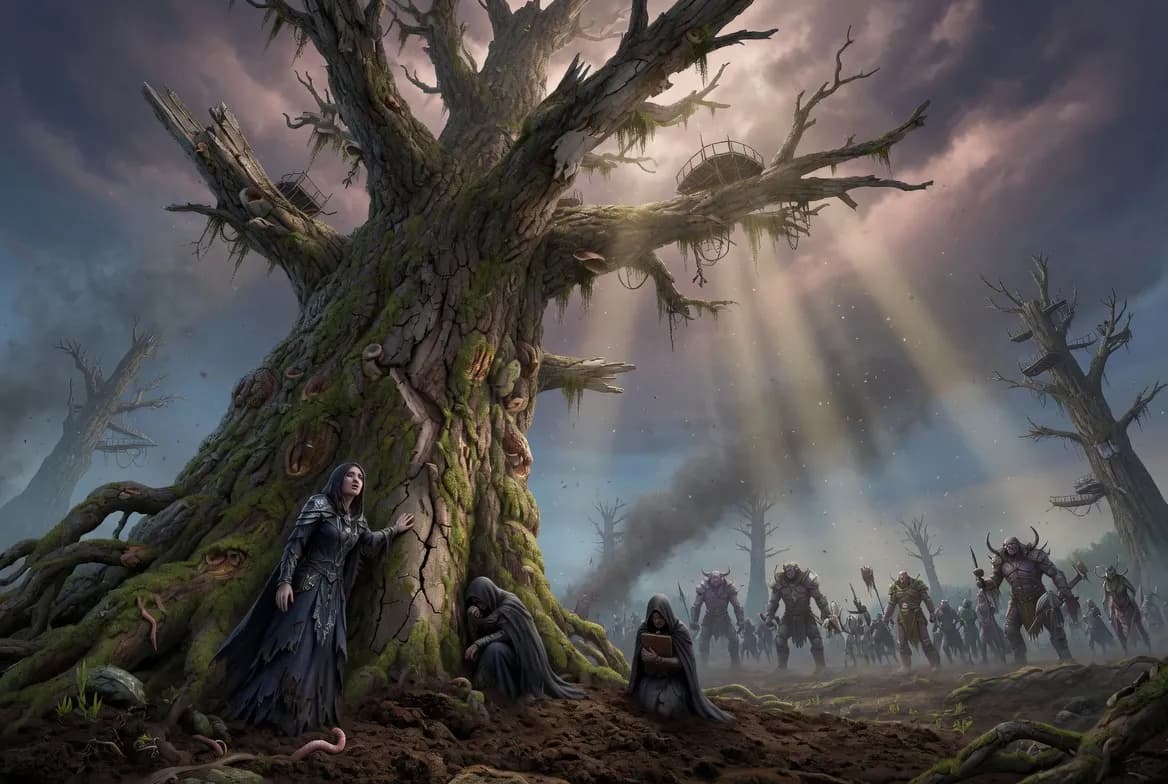
Feladan was consumed. The great city-tree, the oldest living thing on Aradoth, the crown jewel of Vaelith civilization, the place where the echo of Aethon's voice was said to be strongest, swallowed by the Blight. Not destroyed in any conventional sense. Not burned or broken or knocked down. Simply... unmade. The Blight did not destroy things. It subtracted them. It removed the quality of being-a-thing from the matter that composed them, leaving behind grey husks that had the shape of what they had been but none of the substance. Feladan still stood. Its roots still gripped the earth. Its branches still reached for the sky. But it was grey, and brittle, and the echo that had hummed in its heartwood for ten thousand years was silent.
Seven hundred Dryathi were dead. Seven hundred lives ended in a single instant, their deaths felt by every member of their species as a personal wound. The Dryathi had no graves to visit, no bodies to mourn over. The ritual chamber was at the epicenter of the Blight, inaccessible, unreachable, a place where reality itself had been ruptured beyond repair. The seven hundred simply ceased. Their names, preserved in the Rootsong, became a frequency of grief that would vibrate through the Dryathi consciousness forever.
The Great Forest was burning. Not with fire, but with the absence of life, which is worse. Fire consumes, but it also transforms; a burned forest can regrow, given time and rain. The Blight did not transform. It subtracted. The trees went grey. The soil went grey. The streams ran dark, not with pollution but with the removal of clarity, the subtraction of the quality that makes water water rather than merely H2O. The forest did not die. It was unspoken. And unspoken things cannot be regrown, because the word that made them has been removed from the vocabulary of creation.
The Vaelith Sovereignty, the greatest civilization the world had known, the culture that had produced the finest art, the deepest philosophy, the most sophisticated magic, the most beautiful architecture, cracked like a dropped cup. Not from military defeat. Not from economic collapse. From shame. The Vaelith had done this. Their king, their mages, their ambition, their arrogance, their belief that the world was a mechanism to be optimized rather than a gift to be tended. The other races did not need to punish the Vaelith. The Vaelith punished themselves, and their punishment was the worst kind: understanding.
And somewhere, in a place that was not a place, beyond the torn barrier, in the grey expanse where reality had been unmade, the Blight continued to pour through the wound that Aeloran had opened.
It had not stopped.
It would not stop.
The Breaking was not an event. It was a beginning. The moment the world broke was also the moment the world began its long, slow education in the cost of what it had taken for granted. The echo of creation had been fading for millennia, and no one had paid attention. The caesurae had been growing, and no one had taken them seriously. The Dryathi had been screaming in silence for two hundred years, and no one had listened.
Now the silence had teeth. And the world, broken and bleeding and finally, terribly awake, had to decide what to do about it.
The song was breaking. The pause between verses had become a silence. And in the silence, something was listening.
Thus ends the account of the Breaking: the wound that would not heal, the silence that would not end, the moment that divided the world into before and after. What follows is the long retreat, the grey tide, the desperate years. But that is the next chapter's burden to bear.
Select text to add a note.