The Tests of the Maker
"He never asked if you were ready. That was part of the test." — Khellen's Lament, from the Forge Songs of Grayhold
The tests were never fair.
Every grandmother says this first when she tells these stories. The Forge-singers chant it before they begin. The Conclave elders impress it upon their young before anything else. The tests were never fair. They were not meant to be. Fairness is a word mortals use when they want the world to be smaller than it is. Aethon did not deal in smallness.
He walked among his peoples, the made, the spoken, the alive, and he watched them with the love of a parent who knows that love alone is not enough. Love without trial is indulgence. Indulgence without consequence is rot. And so he tested them, each race according to its nature, each test shaped like a blade designed to cut precisely where it needed to cut.
Some of those tests became scripture. Some became silence. This is the record of both.
I. The Forge and the Blade
Being the Test of the Grundir, as preserved in the Forge Songs of Grayhold
Grayhold was young.
Three levels deep. Barely a scratch in the mountain's hide, barely a throat clearing in the deep stone's long conversation with itself. The corridors still smelled of fresh-cut rock and the copper tang of new-forged hinges. The great forges had been burning for less than a generation, and already the Grundir who tended them spoke of their fires the way other races spoke of rivers: as things that had always been and always would be.
It was into this young, proud place that Aethon came walking.
He arrived without ceremony or announcement, without the trembling of the earth or the singing of the deep stone that later stories would attribute to his every footfall. He simply appeared at the entrance to the First Forge on a morning like any other, wearing a traveler's cloak too thin for the mountain cold and boots that had seen a thousand roads. The Grundir at the gate almost turned him away. He was tall for a Grundir, too tall, with proportions that didn't sit right in the eye, as if someone had described a Grundir from memory and gotten most of the details correct but none of the feeling.
"I need a blade," he said.
The gate-keeper, whose name has not survived the centuries, looked at the stranger and felt something move in his chest. Not fear or awe, but the deep geological unease of a mountain sensing a tremor far below. He brought the stranger to Master Forger Khellen.
Khellen was not old. The Forge Songs are careful to note this. He was in his middle years, strong-armed and clear-eyed, a craftsman of genuine skill but not yet legendary. He had forged blades that sang true and helms that turned any edge. He was proud of his work in the uncomplicated way of a person who has not yet been humbled. He looked at the stranger, saw someone who needed a blade, and said, "What kind?"
"The best you can make," Aethon said.
Khellen smiled. He had been waiting for someone to ask.
He worked for seven days. He selected the finest ore from the deep veins, iron that had been compressed by the mountain's weight for millennia, iron that hummed when you held it to your ear. He smelted it in the First Forge's heart, where the fire burned hottest and steadiest, where the heat was so even that a candle flame would have stood perfectly still in the updraft. He folded the metal. He hammered it with the patience that was his birthright, the patience of a race that understood stone's timescale. He quenched it in spring water carried from the Silvervein, the underground river that ran cold and pure through Grayhold's deepest level.
On the seventh day, he presented the blade to Aethon.
It was, by any measure, a masterwork. The edge could part a drifting hair. The balance was so precise that it seemed to float in the hand, weightless and eager, as if it understood its purpose and was impatient to fulfill it. The other smiths gathered to watch the presentation, and a murmur of genuine admiration passed through them. The Grundir do not praise lightly, and this was a blade that earned praise.
Aethon took the sword. He held it up to the forge-light and examined it. The glow played along the edge like a living thing, fire remembering its kinship with steel. For a long moment, he was still.
Then he set the blade across his knee and broke it.
The sound was obscene. A crack like bone splitting. The two halves clattered to the stone floor, and the Grundir watching flinched as if the breaking had been done to them. Khellen stared at the pieces of his finest work, and something behind his eyes shifted, a tectonic plate of self-understanding grinding against a new and unwelcome reality.
"Make a better one," Aethon said.
His voice was not cruel. The Forge Songs emphasize this. The grandmothers repeat it when the children's eyes go wide. He was not cruel. He was not testing Khellen's pride or trying to wound him. He was stating a fact with the same dispassion as a mountain stating its height. The blade was not good enough. Make a better one.
Khellen gathered the broken halves. He held them in his broad hands and felt their edges, felt where the fracture had run, felt the flaw in the steel that he had not detected. A flaw so subtle that no other smith in Grayhold would have found it, a whisper of impurity that Aethon's knee had spoken into a shout. He set the pieces on his workbench and did not leave the forge for fourteen days.
He ate what his apprentices brought him, though he barely tasted it. He slept in two-hour snatches on the stone bench beside the anvil, dreaming of fire and metal, waking with new techniques crystallizing in his mind like ore forming in the deep earth. He started over three times, discarding steel that would have made any other smith proud, because he could feel it now. He could feel the invisible imperfections that Aethon's casual destruction had taught him to perceive.
On the fourteenth day, he produced a blade that sang.
Not metaphorically. When the sword was swung through the air, it produced a note, clear and true and resonant, living somewhere between music and mathematics. The blade had been forged so precisely, tempered so exactly, balanced so perfectly that the air itself became its instrument. The other Grundir stood in the forge and listened to Khellen swing the blade in slow arcs, and the sound it made brought tears to the eyes of smiths who had not wept since childhood.
Khellen brought the singing blade to Aethon. He held it out with hands that trembled, not with fear but with exhaustion and something fiercer than pride. Something like defiance. Break this, his eyes said. I dare you.
Aethon took the blade. He listened to it sing. He closed his eyes, and for a moment his face wore an expression the watching Grundir could not read. Something vast and private, calibrated for senses they did not possess.
Then he opened his eyes and threw the blade into the deep forge fire.
The metal screamed. There is no other word for it. The singing blade, plunged into the forge's white-hot heart, let out a sound that was the inverse of its music, a shriek of dissolution, of perfection being unmade, of beauty returning to raw material. The Grundir covered their ears. Khellen did not. He stood with his arms at his sides and watched his fourteen days burn, and the expression on his face was the expression of a mountain enduring an earthquake. Stone does not cry out. Stone endures.
"Make a better one," Aethon said.
The other smiths looked at Khellen with something between pity and horror. Some of them left. They could not watch this. Later, in the quiet of their own forges, they would feel ashamed of leaving, but in the moment, the sight of so much excellence destroyed so casually was more than they could bear.
Khellen turned back to his forge.
Thirty days.
Thirty days in which Khellen ceased to be a craftsman and became something else. Something without a word in the Grundir language, something the Forge Songs can only describe through metaphor. He was a river wearing through stone. He was a seed splitting rock. He was the patient, inexorable force that transforms the possible into the actual through sheer refusal to stop.
He used every technique he knew. Then he invented three new ones. The first came to him on the ninth day, when exhaustion had stripped away the assumptions he had carried his whole life about how metal behaved under heat. The second came on the fifteenth day, when he realized that the fold pattern he had been taught as an apprentice was an approximation of something more fundamental, a deeper truth about the relationship between force and form that no Grundir had ever articulated. The third came on the twenty-third day, in a moment of clarity so absolute that he would later describe it as hearing a single note of Aethon's creation voice, just one note, faint and impossibly distant, like hearing thunder from the other side of the world.
He barely ate. He barely slept. His apprentices watched him with the worried reverence of acolytes tending a prophet. His hands bled and healed and bled again. His eyes, reddened by forge-smoke and sleeplessness, saw things in the metal that no eyes had seen before. Structures within structures, patterns within patterns, the deep grammar of matter that Aethon had spoken into existence and that Khellen was now, letter by painstaking letter, learning to read.
On the thirtieth day, he finished the blade.
The other Grundir wept.
Not the quiet, private tears of the singing blade's audience. This was different. Smiths who had worked metal for fifty years looked at Khellen's third blade and felt something rupture in their understanding of what was possible. The sword was not merely well-made. It was not merely beautiful. It was true in a way that transcended craftsmanship and entered the territory of revelation. Looking at it was like looking at a perfect equation, a geometric proof, a sunset. Something that simply was, without excess or deficit, without the gap between intention and execution that haunts every mortal work.
Khellen brought the blade to Aethon. He did not tremble this time. He was beyond trembling, beyond defiance. He had been broken and burned and he was still here, still forging, still making, and if Aethon destroyed this blade too, he would make another, and another, and another, until his hands were dust and his forge was cold, because that is what it means to be Grundir. You do not stop. You endure.
Aethon took the blade.
He examined it for a long time. He ran his thumb along the flat. He held it to the light. He did not swing it. The blade did not sing, because it had gone beyond singing into a silence more eloquent than any sound.
He set it gently on the anvil.
"This one," he said, "is adequate."
And then, before Khellen could react, before the word adequate could wound or enrage, Aethon leaned close and spoke three words.
Not in the Common Speech. Not in the Grundir's own rumbling tongue. In the language that had made the world. Three words from the original utterance, three syllables of the voice that had spoken stone and fire and time into existence. They were short words, hard words, words that felt like hammer-strikes on the ear and tasted like hot metal on the tongue. Khellen heard them and felt them engrave themselves on his memory the way a chisel engraves stone. Permanently, irrevocably, down to the bone.
"Speak these as you forge," Aethon said, "and the metal will remember what it was before it was metal. It will remember being part of the word. And it will carry that memory in its edge and its strength and its song."
Then he turned and walked out of Grayhold, and the mountain trembled once, gently, the way a parent touches a sleeping child's forehead, and was still.
Khellen forged one more blade before he died: a short sword imbued with all three words, a weapon that could cut shadow and mend bone and sing a note that made the deep stone weep. It is lost now. So are the words. Ten thousand years of Grundir scholarship have recovered echoes, fragments of fragments, approximations of approximations, and those echoes are the foundation of every masterwork the Grundir have produced since. But the original words, the pure words, the ones that Aethon spoke to a broken and burned and unbreakable smith in a young forge in a young mountain, those are gone.
The Grundir tell this story to every apprentice on the day they first touch the anvil. The moral is not subtle, and the Grundir do not want it to be:
Mastery is not achieved at the first attempt, or the second. It is achieved when you have been broken and burned and kept going anyway. Only then are you ready to learn.
II. The Old Hunter
Being the Test of the Kithara, as told by the Moon-Speakers of every Pride
Every Pride tells this story differently. The name of the Pride changes. The terrain changes: coastal cliffs in one telling, golden savanna in another, dense forest in a third. The season changes, the prey changes, the number of hunters changes. But the bones are always the same, and the bones are these:
Aethon came as a stranger, and the stranger was slow.
The Pride was camped at the edge of the Whispering Reach, or the Thorngrass Expanse, or the cliffs above Moonwater Bay, depending on whose grandmother is telling the story. It was hunting season, and the hunters had gathered in the predawn darkness, checking their spears and flexing their claws, their eyes bright in the way that Kithara eyes get when the hunt is near: contracted pupils, heightened contrast, the world reduced to movement and stillness.
He appeared at the edge of the firelight. An old cat-person, lean and scarred, with a torn ear and a coat gone grey at the muzzle. He walked with a slight limp. His claws, when he extended them, were yellowed and blunt. He smelled of road-dust and old leather and something else, something faint and unplaceable that the Kithara's keen noses registered but could not categorize.
"I would hunt with you," he said.
The hunters looked at each other. Some of them laughed, not meanly, but with the frank assessment of a people who live in their bodies and judge others by the same standard. This old one could not keep up. That much was obvious from the way he stood, the way he breathed, the way his weight settled unevenly on his feet.
But the Kithara accept anyone who asks to hunt. This is old law, older than memory, rooted in the understanding that the hunt is not a privilege to be earned but a right of the living. You hunt or you die. Even the slow, even the old, even the scarred.
The Pride leader, and here the stories diverge most sharply, some naming a female called Tessaya, others a male called Renn, still others simply calling the leader First-Among-Claws, nodded. "You hunt with us. Keep up or fall behind. We will not slow for you."
The old cat-person smiled, showing teeth that were worn and uneven. "I ask only to be part of the hunt."
They ran at dawn.
The Kithara hunt in a formation they call the Crescent, a sweeping arc of runners that drives prey toward a narrow channel where the fastest hunters wait. It requires speed, coordination, and above all, silence. Each hunter must move as a single muscle in a larger body, each footfall placed with the precision of a heartbeat, each breath controlled, each impulse subordinated to the rhythm of the group.
The old stranger destroyed the rhythm in the first hundred yards.
He was slow. Painfully, conspicuously slow. His limp worsened at speed, turning his run into a lurching, uneven gait that threw off the timing of the hunters nearest him. He crashed through underbrush that the others flowed around like water. He snapped twigs. He scattered birds. He breathed in great, ragged gasps that could be heard three lengths away. The prey, a herd of silverhorns grazing in the meadow ahead, heard him coming and bolted early, before the Crescent had closed.
The hunters pulled up, frustrated. The silverhorns were gone, vanished into the tree line with the effortless speed of animals that have spent a million years learning to run from things with claws. The old stranger stumbled to a halt behind them, wheezing, his grey fur dark with sweat.
A young hunter named Vessk, and this name is consistent across every telling, turned to the Pride leader with fury in his golden eyes. "This is waste. He costs us meat. Leave him."
Others murmured agreement. The Crescent could not function with a broken runner in its arc. The old one was a liability. Noise where silence was needed, slowness where speed was life. Leaving him was not cruelty. It was practicality.
The Pride leader looked at the old stranger. Looked at him for a long time, with the unblinking Kithara stare that sees movement in stillness and reads the story of a body's life in the way it stands. The old one met the stare and did not look away. There was something in his eyes, a patience, an amusement, a gentle and implacable expectation, that the Pride leader could not quite decipher.
"No," the Pride leader said. "You do not abandon a hunter. Even a bad one. This is old law."
Vessk hissed. "Old law will fill no bellies."
"Then we change how we fill them."
What happened next is the heart of the story, the part that every Kithara child leans forward to hear, the part the Moon-Speakers tell with their voices low and their eyes bright.
They adapted.
The Pride leader redesigned the Crescent on the spot, there in the dappled shade of the tree line, with the old stranger sitting on a rock and watching with those unreadable eyes. Instead of a uniform arc of equally-fast runners, the leader created something new: a layered formation, with the fastest hunters on the wings and the old stranger positioned at the center-rear, where his noise and slowness would serve as a beater, driving prey forward into the closing arc rather than away from it.
It should not have worked. The Crescent was ancient, proven, refined over generations. You do not improve a thing of beauty by breaking its symmetry. And yet.
They found the silverhorns again an hour later, regrouped at a watering hole in a narrow valley. The Pride leader gave the signal. The wings swept wide, silent as shadow, fast as thought. And the old stranger lumbered forward through the center, crashing and gasping and making enough noise for ten hunters, and the silverhorns, confused, panicked, unable to locate the threat because it seemed to come from everywhere at once, loud in the center and silent on the sides, bolted in exactly the wrong direction.
They ran straight into the closing arc.
What followed was not a hunt. It was a revelation. The new formation channeled the herd with a precision the old Crescent had never achieved. The prey could not scatter because the noise behind them drove them forward while the silence on either side gave them no warning of what waited ahead. The fastest hunters struck from angles that would have been impossible in the old formation. The kills were clean, quick, almost gentle.
When the old stranger came stumbling into the kill ground, last and gasping and by every visible measure useless, the hunters were standing over the largest silverhorn anyone had ever seen. Its antlers spread wider than a hunter's arm-span. Its coat shimmered like water under moonlight. It was the kind of kill that Prides sing about for generations, the kind that becomes a marker of time, so that the years are counted as before and after.
The old stranger straightened up. His limp vanished. His wheezing stopped. The grey in his fur seemed to catch the light differently, to hold a luminance that had nothing to do with the sun. And his eyes, those old, tired, watery eyes, became something else entirely. Became deep. Became ancient. Became the eyes of someone who had watched the world being spoken into existence and had loved every word.
The Kithara, for one of the few times in their history, were speechless.
Aethon looked at the fallen silverhorn. Looked at the hunters. Looked at the new formation they had invented, the Layered Crescent, as it would come to be called, a technique that Kithara Prides would use for the next ten thousand years. He nodded once, the way a teacher nods when a student solves a problem they did not know they were working on.
"The hunt is not won by the fastest," he said. "It is won by the group that adapts."
Then he turned to the Pride leader and spoke in a low voice, a voice the other hunters strained to hear but could not quite catch. He spoke of the moons. He spoke of how to listen to them, not with the ears, which hear only sound, but with the self, which can hear meaning. He taught the Moon Vigil: the practice of sitting beneath the two moons on the night they hang closest to the world and speaking your questions into the silver light and waiting, in absolute stillness, for the answers that come not as words but as understanding.
The Pride leader listened. And that night, beneath the double moonlight, the Pride leader performed the first Moon Vigil, and the moons answered.
The Kithara have been listening ever since.
The moral of this test is simpler than the Grundir's, and the Kithara like it that way. They are not a people of complexity. They are a people of motion and adaptation and the fierce, unapologetic present tense:
The weak are not a burden. They are the force that makes the strong change. And change is how you survive.
III. Eight Days of Silence
Being the Test of the Vyssari, as preserved in the Ancestral Current
The Conclave was already ancient when Aethon came to it.
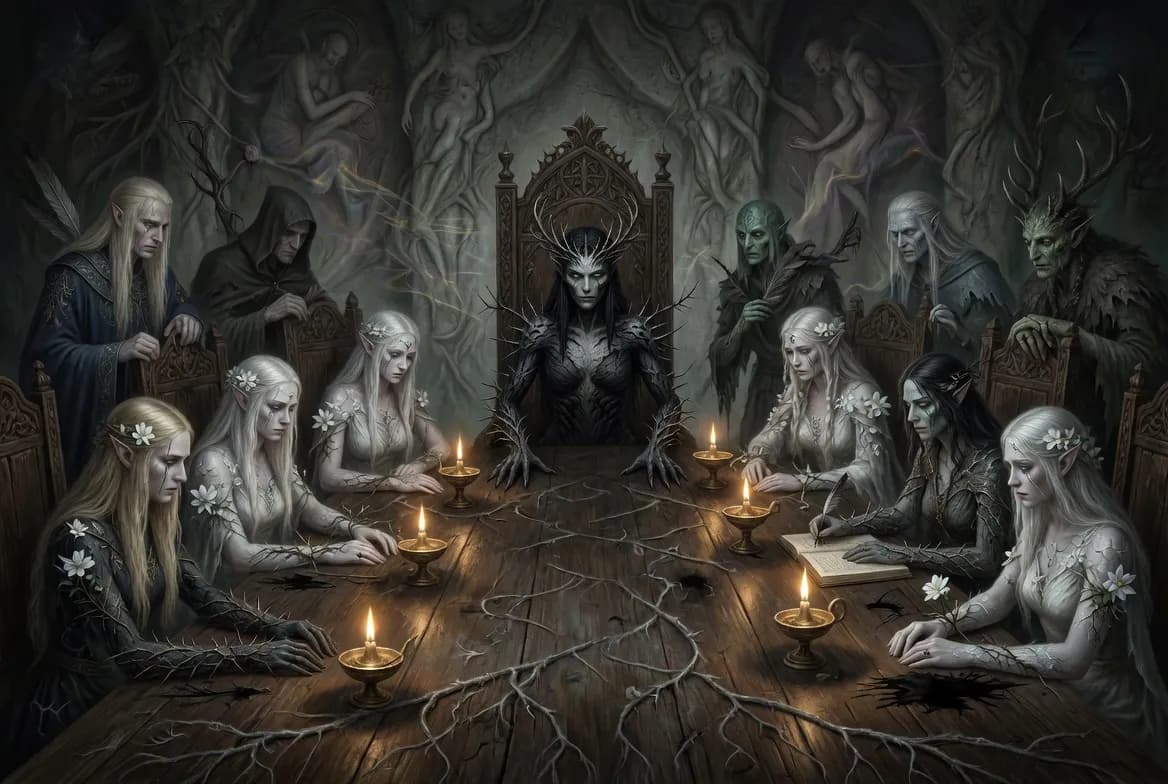
The Vyssari are a patient people, cold-blooded in body and temperament, comfortable with silences that would drive other races to madness. Their Conclave, the council of elders that governed their civilization from the warm swamps of southern Aradoth, had been sitting in deliberation for longer than the Grundir had been forging, longer than the Kithara had been running. Longer, perhaps, than any other institution on the face of the world. The Conclave did not rush. Time, to the Vyssari, was not a river to be raced along but a swamp to be inhabited: deep, slow, rich with things growing beneath the surface.
Aethon arrived at the Conclave chamber on a morning thick with fog and the green smell of standing water. He entered without speaking. He found an empty stone seat among the elders, low and smooth, worn by generations of scaled bodies, and he sat down.
And he said nothing.
The Conclave elders looked at him. They registered his presence the way the swamp registers a new stone: with a slight adjustment of currents, a minor redistribution of weight, and then stillness. They did not ask who he was. They did not ask why he had come. The Vyssari do not ask unnecessary questions. If the stranger wished to speak, he would speak. If he wished to sit, he would sit. The Conclave had been sitting for centuries. One more body in one more chair changed nothing.
The first day passed. The Conclave continued its deliberations, the slow, measured exchange of observations that constituted Vyssari governance. They discussed the health of the southern spawning pools. They considered the movement of certain bird species that suggested a change in weather patterns. They debated, with the unhurried precision of surgeons, whether a particular fishing technique was depleting a particular species of bottom-feeder. The stranger sat among them and said nothing, and they let him say it.
The second day. The third. The elders came and went, cycling through their duties, and Aethon remained. He sat with the preternatural stillness of a creature that does not need to fidget, that has no restless mammalian need to move and shift and resettle. The Vyssari, who valued stillness above almost all other qualities, noticed this. They approved, in their quiet way. Whatever this stranger was, he understood how to wait.
The fourth day. The fifth. Some of the younger Vyssari, those who had not yet fully absorbed the patience of their elders, began to whisper among themselves. Who was this silent visitor? Why did he sit among the Conclave without speaking? Was he testing them? Was he ill? Was he simply strange? The elders silenced these whispers with a look. Patience is not merely a virtue among the Vyssari. It is the foundational architecture of their civilization. If the stranger sat for a hundred years, they would wait a hundred years.
The sixth day. The seventh. A week of silence, and the Conclave continued its work around the silent stone that Aethon had become. He did not eat. He did not drink. He did not sleep, or if he did, his sleeping was indistinguishable from his waking: the same absolute stillness, the same half-lidded eyes reflecting the swamp light like dark water.
On the eighth day, Aethon spoke.
The sound of his voice after seven days of silence was like the first drop of rain after a drought. Small, quiet, and containing within it the implicit promise of a flood. Every elder in the chamber turned toward him. Every membrane-covered eye focused with the slow precision of a lens adjusting.
"A question," Aethon said.
The eldest of the Conclave, a Vyssari so old that the scales on her throat had gone from green to pale gold, so old that her name had been shortened by generations of use until it was simply Sah, inclined her head. "Ask."
"If you could know everything," Aethon said, "every secret, every truth, every answer to every question that has ever been asked or ever will be asked, but the price was that you could never share it with anyone, would you accept?"
The chamber went still. Not the ordinary stillness of the Conclave, which was a living stillness, full of thought and slow circulation. This was different. This was the stillness of minds encountering something genuinely new.
Sah did not answer immediately. None of them did. The Vyssari do not offer hasty responses to questions that deserve deliberation. She looked at Aethon with those ancient golden eyes, and whatever she saw in his face, whatever she read in the stillness of his body and the depth of his gaze, told her that this was not a casual question. This was a test. And the answer mattered in ways she could sense but not yet articulate.
"We will consider," she said.
Three days.
For three days, the Conclave did nothing else. They set aside the spawning pools and the bird migrations and the bottom-feeders. They gave themselves entirely to Aethon's question, turning it over and over in their patient minds the way the swamp turns a fallen log, slowly, thoroughly, breaking it down into its parts until the truth at its core is revealed.
The arguments for acceptance were substantial. Total knowledge, every secret, every truth, would mean the end of uncertainty, the end of error, the end of the slow and painful process of discovery that had consumed Vyssari civilization for its entire history. A Vyssari who knew everything would be, in a meaningful sense, complete. The ultimate expression of the Vyssari drive to observe, understand, and catalogue the world.
But.
The arguments against acceptance were quieter, and they ran deeper.
An elder named Thress, young by Conclave standards, barely two centuries old, posed the question that cracked the deliberation open: "What is the difference between a Vyssari who knows everything and cannot share it, and a stone at the bottom of the swamp?"
Silence. The productive kind.
Another elder, Kovaan, added: "We do not observe the world for ourselves. We observe it so that the observation can be placed in context, challenged, refined, combined with other observations. Knowledge that exists in only one mind is not knowledge. It is data. Knowledge becomes knowledge only when it moves between minds, when it is tested against other knowledge, when it changes and is changed by the knowing."
And Sah, the eldest, said the thing that ended the deliberation: "Knowledge that cannot be shared is not a gift. It is a cage. We would be the most informed prisoners in creation, but prisoners all the same."
On the third day of deliberation, the eleventh day since Aethon had entered the Conclave chamber, the elders gave their answer.
"No," Sah said. "We refuse."
Aethon looked at her. Looked at all of them, his gaze moving from face to face with a slow, deliberate attention that seemed to see not just their surfaces but their depths. The centuries of thought and patience and accumulated wisdom that had produced this answer.
And he smiled.
The Forge Songs record Aethon's laughter. The Moon-Speakers record his approval. But a smile, an actual smile, the expression of a joy so quiet and so deep that it can only be worn, not spoken, is nearly unique in all the stories of the Maker. The Vyssari treasure it above almost anything else in their long history. They made a god smile. They gave the correct answer to an unanswerable question, and the creator of the world was pleased.
"You understand," Aethon said, "what many never will. That wisdom is not a thing you hold. It is a thing that moves. It must flow, or it stagnates. It must be given, or it rots. You are the keepers of observation, the archivists of the world, but you are not vaults. You are rivers."
Then he did something the Vyssari have spent ten thousand years trying to fully comprehend. He opened the Ancestral Current.
It began as a sound, or not a sound exactly, but a vibration, a resonance, a frequency that the Vyssari felt not in their ears but in the deep architecture of their being. It was the hum of connection, of minds linking to minds across time and space, of memory becoming communal, of experience becoming shared. Every Vyssari in the Conclave chamber felt it at the same moment: a sudden, overwhelming awareness of every other Vyssari who had ever lived.
Not as ghosts. Not as voices. As memories. Every observation, every sensation, every moment of quiet contemplation or sudden insight or slow, patient understanding that any Vyssari had ever experienced, all of it was there, preserved in a substrate that transcended individual death, accessible to any Vyssari who knew how to listen. The Current was not magic, though it felt like magic. It was not faith, though it inspired faith. It was the Vyssari inheritance: the gift of a god who had watched a race of patient, quiet, cold-blooded observers choose sharing over possession, and had decided they were ready for the weight of communal memory.
Sah wept. The Vyssari do not weep often, their physiology does not encourage it, but on the day the Current opened, the eldest elder in the Conclave chamber felt tears track down her golden scales, and she did not wipe them away. She was feeling, for the first time, the memories of Vyssari who had died before she was born. She was experiencing sunsets she had never seen, thoughts she had never thought, moments of beauty and sorrow and understanding that belonged to other minds but were now, in the deepest sense, also hers.
"Guard this," Aethon said. "It is not a gift given once. It is a gift that must be earned continuously, by every generation, through the act of sharing what you know. The moment you hoard it, the moment any Vyssari uses the Current as a vault instead of a river, it will begin to die."
Then he left the swamp, and the fog closed behind him like a curtain, and the Conclave sat in silence for a long time, listening to the sound of ten thousand years of memory flowing through them like water through roots.
The moral of this test is the one the Vyssari inscribe on the walls of every hatchery, the first thing every young Vyssari reads when their eyes first focus:
Wisdom is not possession. It is circulation.
IV. The Tests That Are Not Told
Not all of Aethon's tests ended in gifts. Some ended in fire.
The Hearthborn keep fragments of a story, broken pieces like pottery shards found in ash, about a test that their ancestors failed. The details are unclear, because the Hearthborn who might have recorded them did not survive to do so. What remains is this: there was a city. It was built quickly, in the way that Hearthborn build, with ambition and energy and the restless, relentless drive to make something more. The city grew outward and upward and consumed the land around it. Forests fell. Rivers were diverted. The soil, stripped of its cover, began to wash away in the rains.
Aethon came to the city. He looked at what the Hearthborn had built. And whatever test he posed, whatever question he asked, whatever trial he set, the Hearthborn failed it. The city burned. Not by lightning or accident or war, but by the deliberate hand of the god who had made the world and who would not watch it consumed by those he had placed upon it.
The Hearthborn do not like telling this story. When pressed, they speak of it in generalities, with averted eyes and careful language. The lesson, growth without stewardship is cancer, is carved into the oldest stones of their oldest surviving cities, but it sits there like a scar: acknowledged, not discussed, and not, if one looks honestly at the Hearthborn's subsequent history, fully learned.
The Vaelith have a story that is even more troubling, because it is not fragmentary but sealed. Somewhere in the deepest archives of House Veylith, the oldest and most secretive of the Vaelith noble houses, there exists an account of a test that Aethon posed to the greatest Vaelith king. The king failed. That much is known, whispered in the halls of Vaelith academies, referenced obliquely in their oldest poems. But the nature of the test, the nature of the failure, and the consequences of that failure are locked behind wards and oaths and the kind of institutional silence that only a race as proud as the Vaelith can maintain for millennia.
What did Aethon ask of the Vaelith king? What was the question that the most beautiful, most cultured, most refined of all the races could not answer correctly? And what was lost as a result?
The Vaelith do not say. House Veylith does not say. The archives remain sealed.
There are scholars, mostly Vyssari with their irritating patience and their access to the Current's deep memories, who believe that the Vaelith's sealed test is connected to their later history: the pride that became arrogance, the beauty that became vanity, the civilization that reached for the voice of God and broke the world in reaching. But this is speculation, and the Vyssari, to their credit, label it as such.
What is not speculation is this: Aethon tested every race. Some passed. Some failed. And the gifts he gave, the three words of forging, the Moon Vigil, the Ancestral Current, were not rewards for cleverness or strength. They were tools, given to peoples who had demonstrated the one quality that the Maker valued above all others:
The willingness to become something new.
The Grundir became new through endurance. The Kithara became new through adaptation. The Vyssari became new through the refusal to hoard what they knew. Each race passed its test not by being what it already was, but by allowing the test to change it into something it had not yet imagined.
And the races that failed? Perhaps they failed because they could not change. Perhaps they failed because they would not. The distinction, in the end, matters less than the result.
Aethon tested the world, and the world answered. Some answers pleased him. Some did not.
But he kept walking.
"He asked me to make three blades. But the thing he was forging was me." — Khellen, Last Words (attributed), from the Forge Songs of Grayhold
Select text to add a note.